

Two days ago I was trying to photograph other birds in flight when my peripheral vision spotted a pair of small ducks coming in fast from my right to land on the water. They turned out to be Ring-necked Ducks, a species that I haven’t seen since about a year ago.
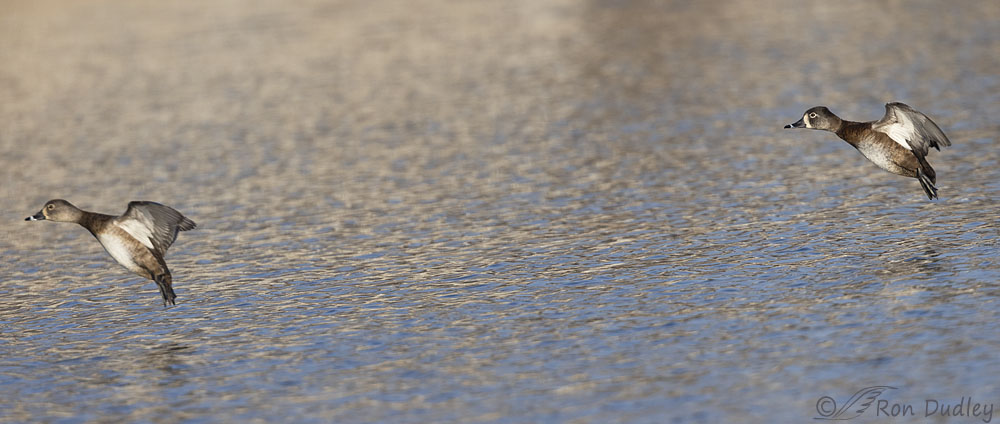
1/4000, f/5.6, ISO 800, Canon R5, Canon EF500mm f/4L IS II USM + 1.4 tc
I barely had time to get my lens on them before they hit the water. Here the bird on the right is sharp but the one on the left is a little soft. The only reason I’m including this photo is to show that there were two birds coming in, which will explain something you’ll see in several of the photos below.
This is the last shot that had two birds in the frame in flight. The rest of them include only the duck on the right, that I believe is an adult female.
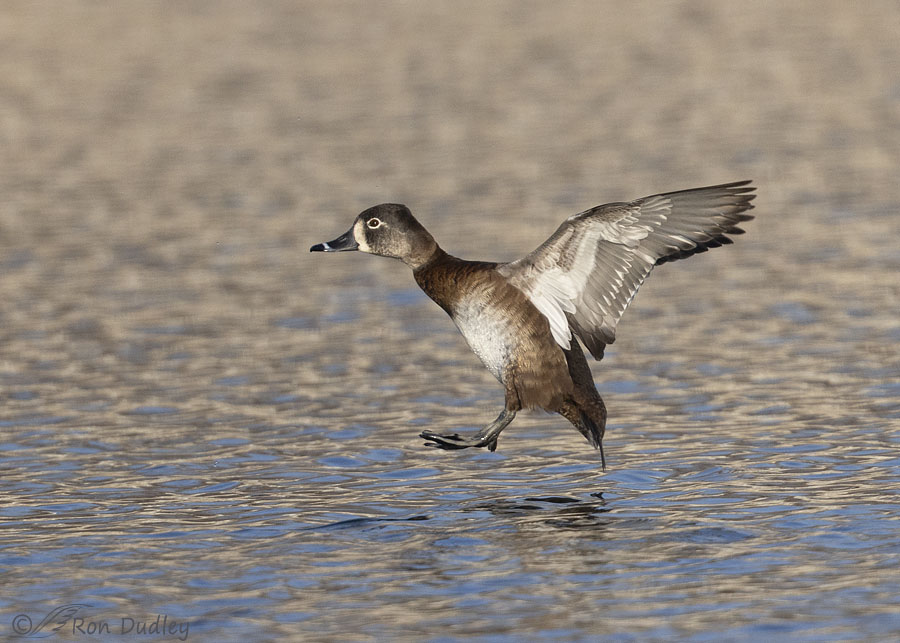
1/4000, f/5.6, ISO 800, Canon R5, Canon EF500mm f/4L IS II USM + 1.4 tc
Skimming just above the water’s surface.
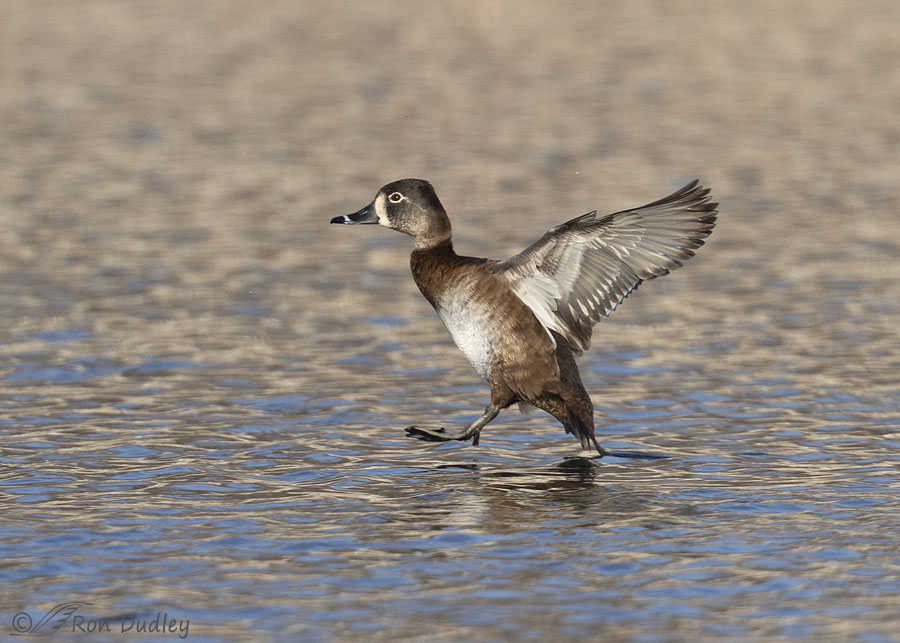
1/4000, f/5.6, ISO 800, Canon R5, Canon EF500mm f/4L IS II USM + 1.4 tc
Her tail begins to drag in the water.
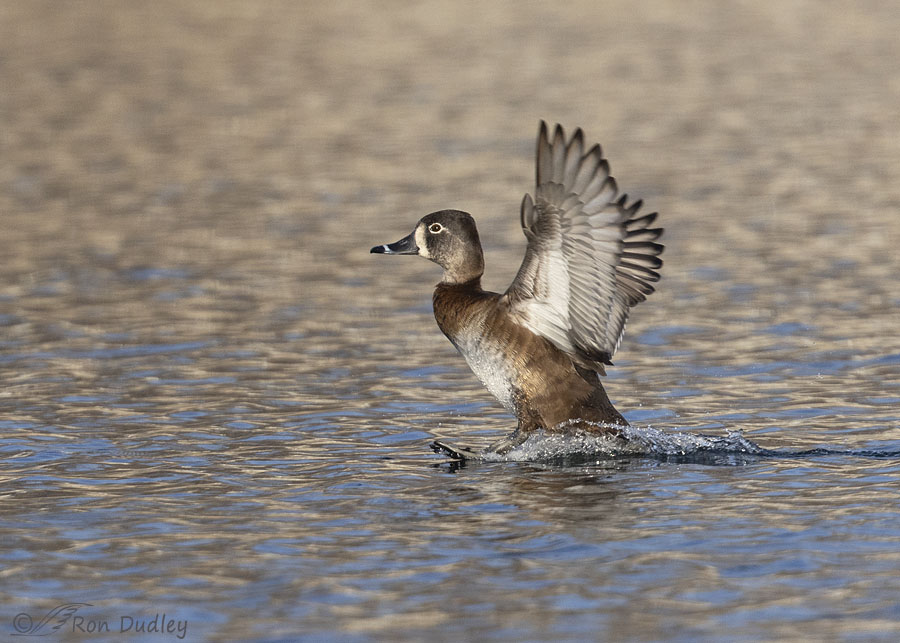
1/4000, f/5.6, ISO 800, Canon R5, Canon EF500mm f/4L IS II USM + 1.4 tc
Touch down.
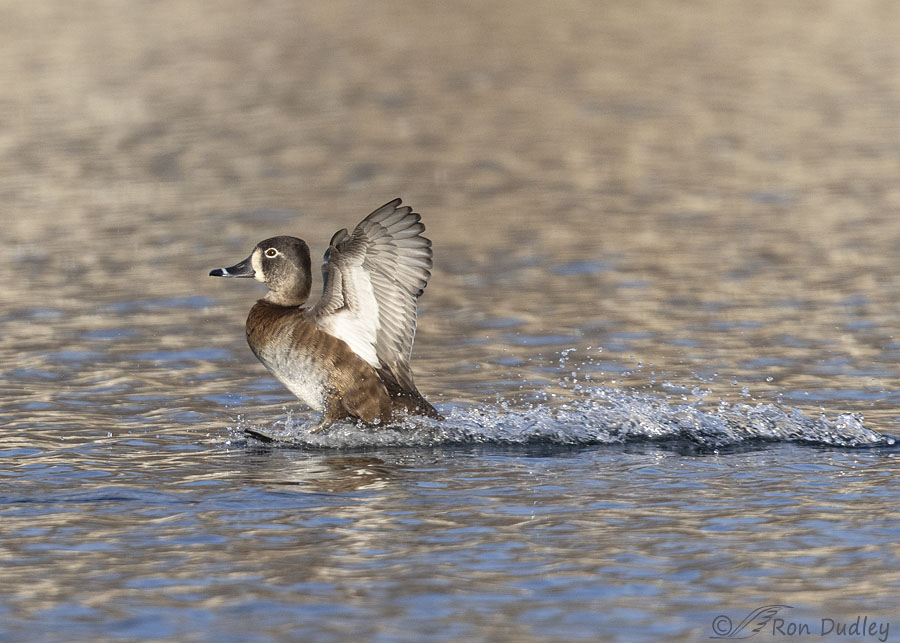
1/3200, f/5.6, ISO 800, Canon R5, Canon EF500mm f/4L IS II USM + 1.4 tc
Water skiing.
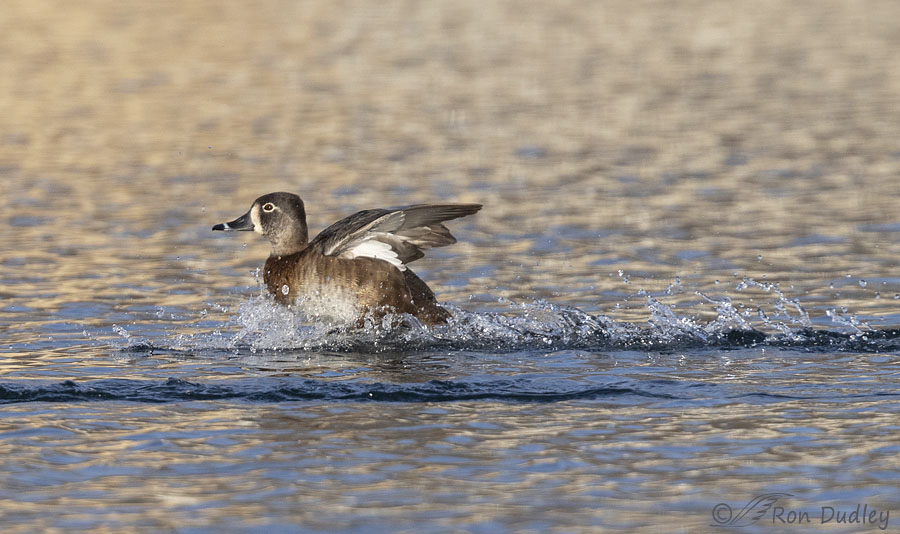
1/3200, f/5.6, ISO 800, Canon R5, Canon EF500mm f/4L IS II USM + 1.4 tc
Here we begin to see the wake of the duck in front of her and the exact spot where that bird hit the water.
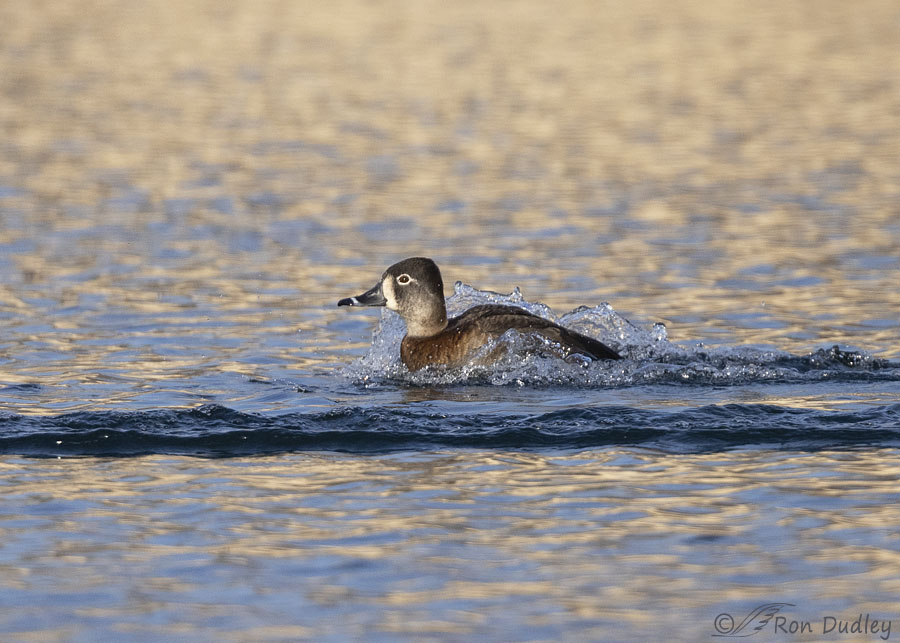
1/3200, f/5.6, ISO 800, Canon R5, Canon EF500mm f/4L IS II USM + 1.4 tc
Coming to a stop.
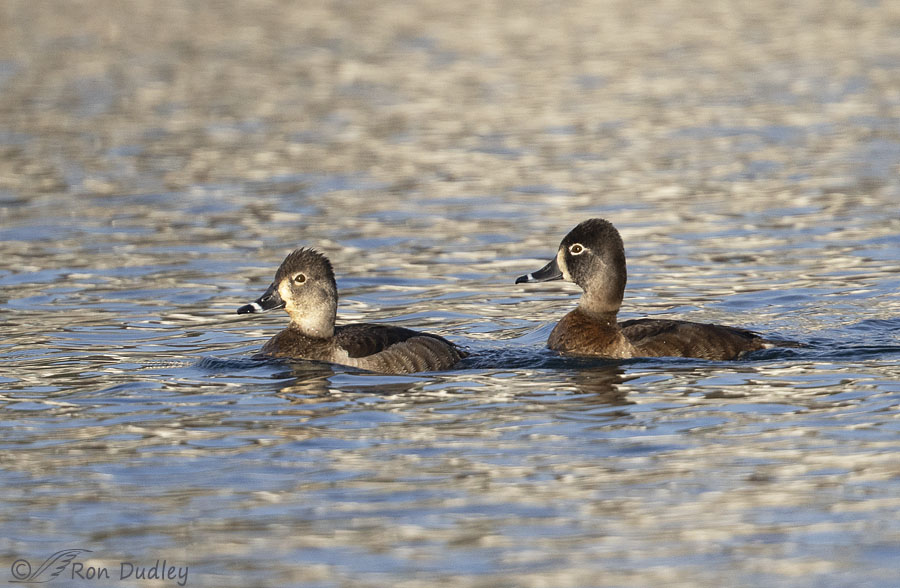
1/4000, f/5.6, ISO 800, Canon R5, Canon EF500mm f/4L IS II USM + 1.4 tc
Three frames later the two ducks had joined up.
I wish they’d been a little closer but if they had been I would have had more difficulty keeping her in the frame. In flight they’re real speedsters.
Female Ring-necked Ducks can be difficult to distinguish from young males in winter but I believe the duck on the right, the one I followed with my lens, is an adult female and the one on the left is a juvenile. Please correct me if I’m wrong. I’m out of my league when it comes to identifying the developmental and seasonal stages of Ring-necked Ducks.
Ron
PS – In case you’re wondering, I got my primary computer back from the shop two days ago. Thankfully they didn’t have to replace the hard drive but it still took me most of a day to get it back up and running properly. My computer is a temperamental SOB and no one will ever accuse me of being a computer geek.
It’s great you got to see Ring-Necked ducks. Thanks for the spectacular photos. It’s interesting to see how the water droplets are frozen in place.
You are so quick to get good shots..following all the way to the water. Super photography & story to go with. Keep up the good work!
Judy, sometimes I’m quick and sometimes I’m not. When I’m not it seems like those are potentially the best shots.
That water looks so clear.
Dozerman, I don’t know how clear it really is. I’m never looking down on it.
They’re handsome ducks, and the action shots are marvelous. I did laugh at my first reaction — after I learned their true identity. Looking at their heads, they looked to me like a combination of a teal and a pied-billed grebe. At least I’ve learned enough to be able to recognize some characteristics of other species!
Shoreacres, because of the white behind their bills, my first thought was that they were teals too. But then the white band on the bill (and a few other things) sent me in another direction.
It’s fascinating to see how the duck’s behavior plays out in the photos—especially how her tail drags just before touching down. You’ve really captured the gracefulness of this bird in motion!
Much appreciated, Nano. I’ll bet the leading duck’s landing behavior was nearly exactly the same.
Thanks for another opportunity to see better than I can on my own. Lovely landing sequence.
Thank you, Pat.
Nice shots, very refreshing as I roast in near-80 degree heat at 10:30 in the morning.🥵 All I know about ducks is, if it walks like a duck and talks like a duck, it probably is a duck. 😬
Glad your ‘puter problems are resolved without too much hassle. May it remain so for the foreseeable future!
Thanks, Chris. We’ve been getting some fairly cold weather but almost no snow.
Excellent photos Ron and ran it by an expert and he agrees
with your ID. One of the most poorly named ducks ever. Way way back ornithologists named this duck while examining dead ones under a light and seeing the vague ring around its neck named it so instead of ring-billed. Handsome ducks though. We have a lot of them at
one of our lakes right now.
Thanks for the confirmation, Everett. And for the explanation of the name origin.
Good news about your hard drive! Whew!
What a wonderful landing series. The movement of the water is just as exciting as the movement of the bird, in my eyes. (I guess you can take the teacher out of the classroom, but…)
Seeing these shots reminds me of a high school classmate who was a barefoot water-skier (and drove a Corvair). Thanks for evoking some fun memories.
Thanks, Marty. Water skiing barefoot and driving a Corvair is REALLY taking your life in your hands.
VERY nice sequence! 🙂 Don’t believe I’ve ever seen one and the name does seem a little weird….. 😉 We too are VERY dry and I’m concerned about the “crick” for next summer not to mention crops. You and me both on NOT being computer “geeks”….. 😉
Judy, as far as I’ve been able to tell (mostly on the GEC webcam) Cut Bank hasn’t been getting much moisture either.
Nice sequence! The 4th one down appears to be the perfect moment!
Thank you, Joanne.
These are wonderful! I am at the sf bay shore (Albany bulb) nearly every day with my dog and have started to pay attention to the waterfowl there – lots of different species; I got a good pair of binocs for my birthday and saw a green winged teal yesterday and the day before! The book I’m using, Birds of Napa Valley, by Hermann Heinzel, has some good illustrations, but they didn’t do this duck Justice!
“they didn’t do this duck Justice!”
That’s often the case with field guides, Nicole. Especially when the “real” bird is in good light.
I WONDERED about the “ring-necked” name too…..who knows
why the subtle feature won out over the obvious ? I liked seeing
the stages of the landing illustrated. –Broken up into separate parts,
the process looked graceful and athletic. Good news about your
computer ! Now if we get some actual winter weather, you’ll at least
be able to do some work inside.
“who knows why the subtle feature won out over the obvious?”
Kris, I’ve wondered about that for a long time.
If we don’t get some snow soon, and lots of it, we’re going to be in big trouble next summer.
Water skiing – LOL
🙂
“Water skiing” wasn’t a caption I expected. Little snort of the coffee accompanied that one!😅 Always a treat to see the neck ring. That’s a detail I usually can’t make out in the field due to distance and lighting. Thinking good thoughts for your computer!
Diane, the neck ring is nearly always difficult to see in this species, in both sexes. Many folks believe that Ring-necked Duck is an inappropriate name for that reason. Ring-billed Duck has been proposed as an alternative.
Nice sequence. Amazed at how they hold such perfect form in their approach to landing.
I wonder if the ability of ducks to make these high speed water landings is intuitive or learned. Have seen other types of birds (mostly hawks) fumble a landing, but I do not recall ever seeing a duck do so. Maybe I have not watched enough duck landings.
Good news about the computer. Must feel good.
“I wonder if the ability of ducks to make these high speed water landings is intuitive or learned.”
Good question, Michael. Maybe it’s a little of both.
I was very relieved that they didn’t have to replace the hard drive. If they had I’m sure I’d be dinking around with it for many more days.
After spending many summers waterskiing…my thought is, do they ever hit a wave unexpectedly and face plant? 😀
Jeff, all this talk about water skiing brought back an unpleasant memory for me.
The first time I suspected I had a bad back that was going to haunt me for the rest of my life was when I was 26 years old and went water skiing in Montana for the first time since high school. I skied all the way around the large lake on one ski, just like I used to do when I was a teenager. Just before I let go of the rope I felt something pop in my back.
After that I could barely walk for nearly a week. That was the last time I ever went water skiing.