

Early last week I was lucky enough to spend 34 minutes with two small flocks of Cedar Waxwings feeding on crabapples.
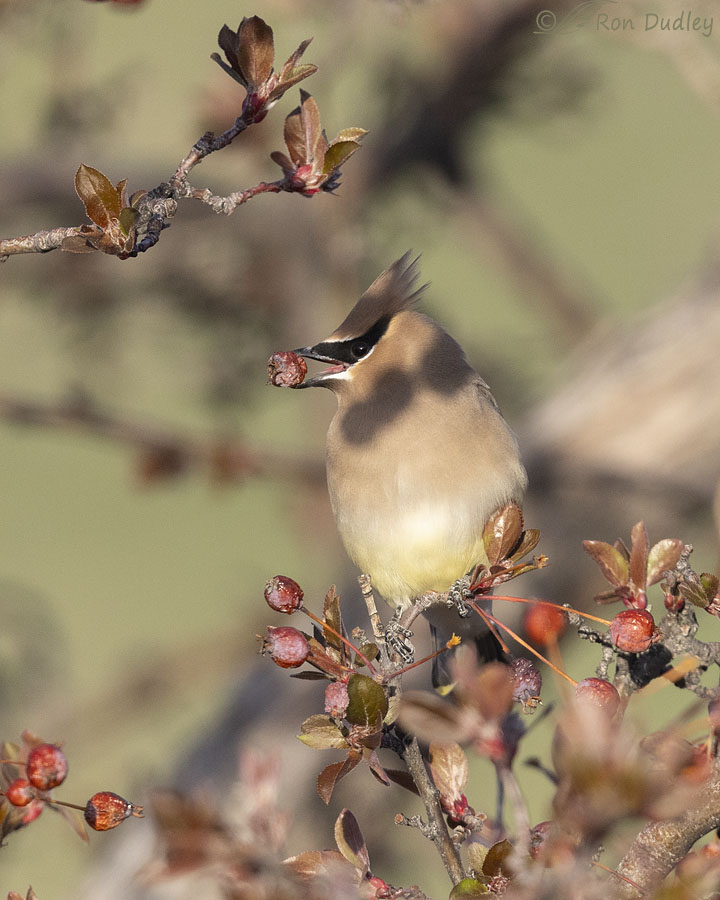
The settings were typically busy which often caused shadows to fall on the birds, but the behaviors were interesting and waxwings are beautiful birds so I did the best I could with what I had.
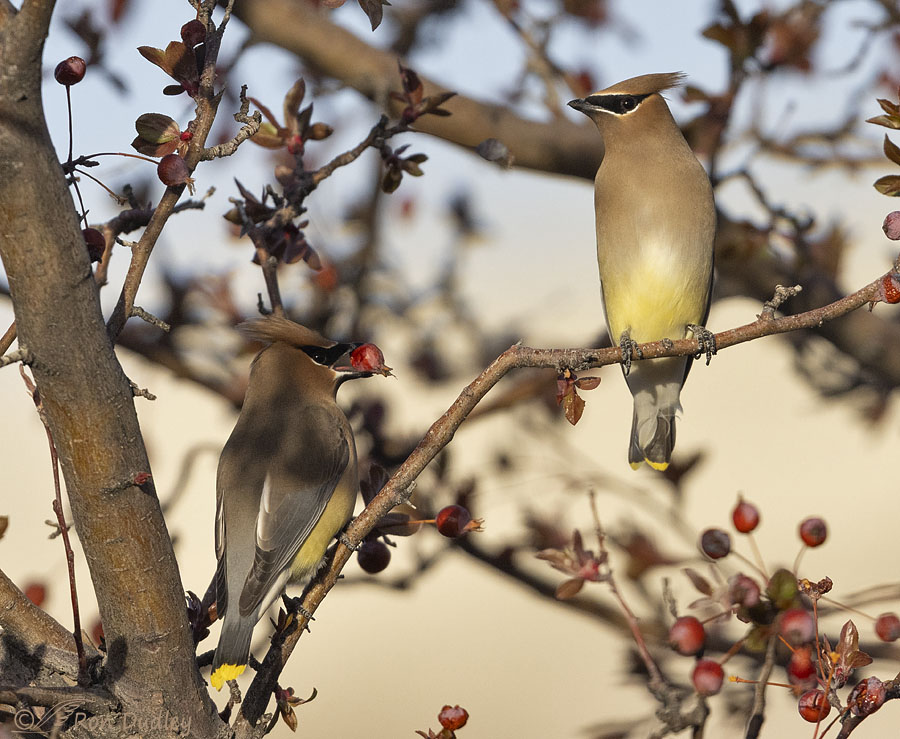
Even though there were lots of waxwings in several crabapple trees that were adjacent to each other, I seldom got more than one bird in the frame – especially with both birds sharp. This photo is an exception.
Most of the birds in both flocks were young birds, lacking the red, waxlike tips on the secondary flight-feathers of adult birds. I only noticed two adults in the time I was with them.
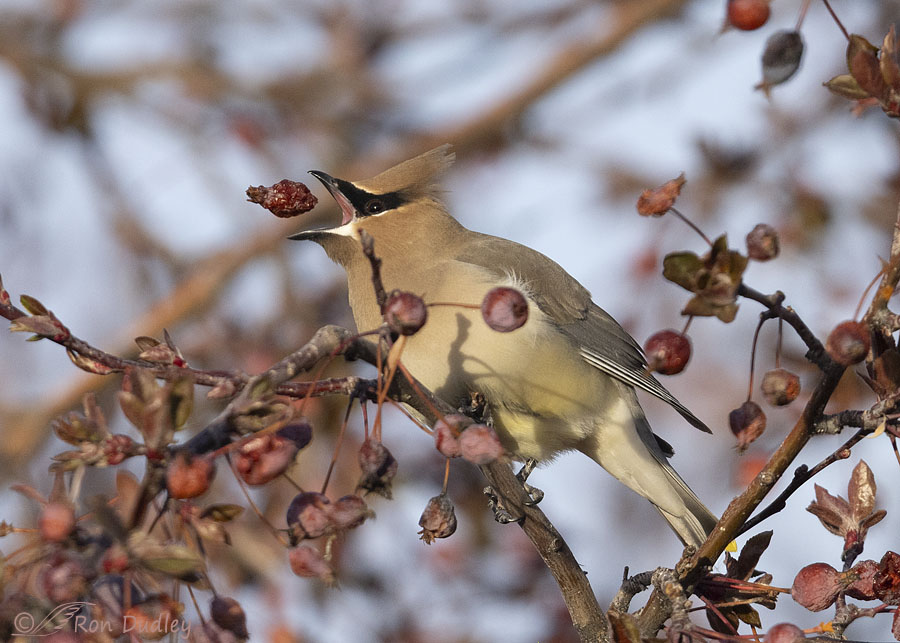
This late in the year some of the crabapples are still plump but many of them are shriveled and wrinkled. It quickly became apparent that still-plump fruits were right at the margin of the size they could swallow. I watched many waxwings attempt to swallow plump fruits and fail.
This bird was wise enough to choose a smaller, wrinkled and perhaps less palatable fruit so it…
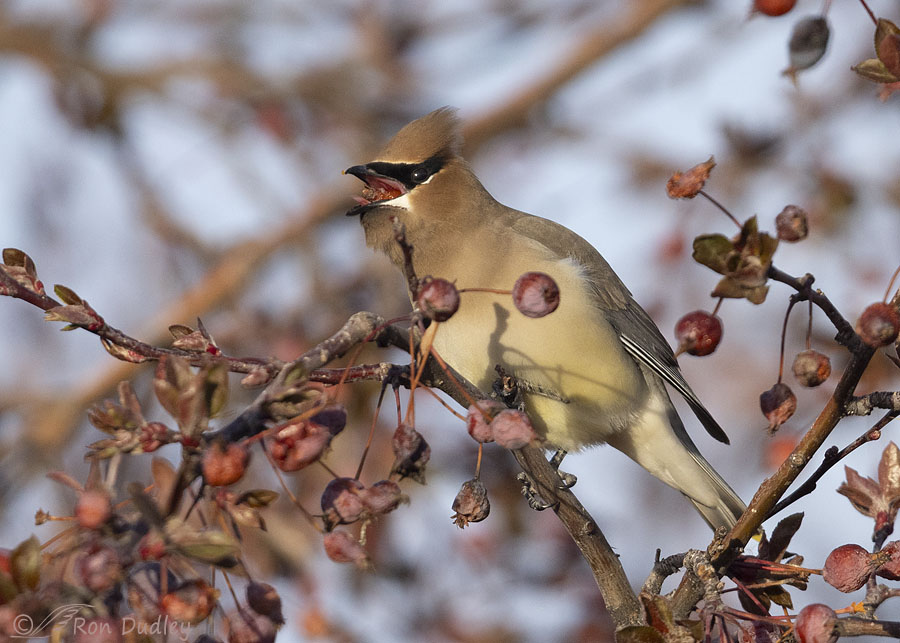
had no trouble at all swallowing it.
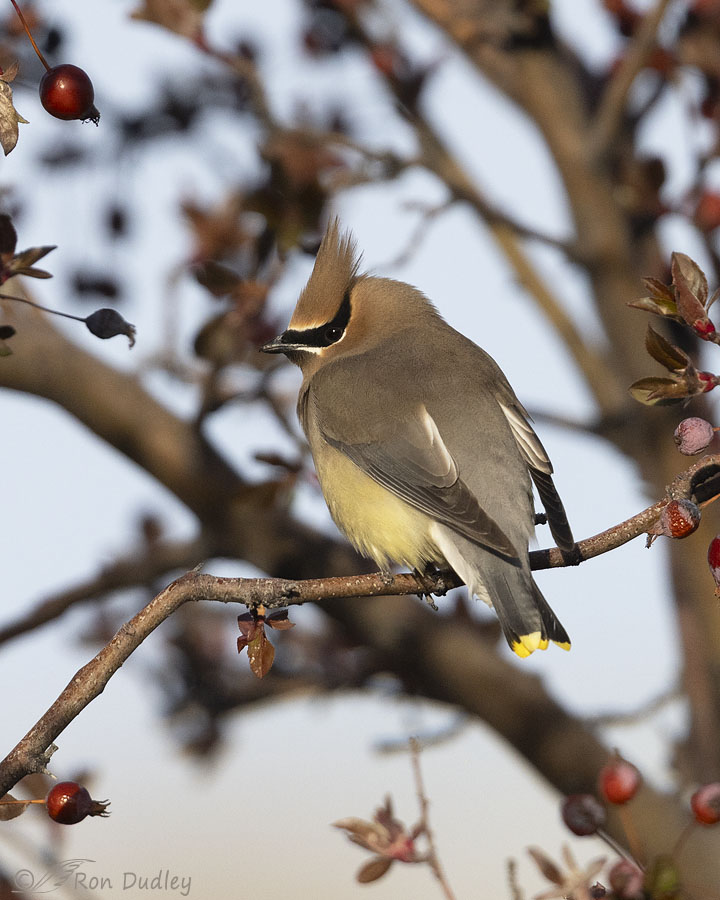
I really missed seeing those distinctive red waxy feather tips on the wings of most of the waxwings but even without them they’re dandy-looking birds.
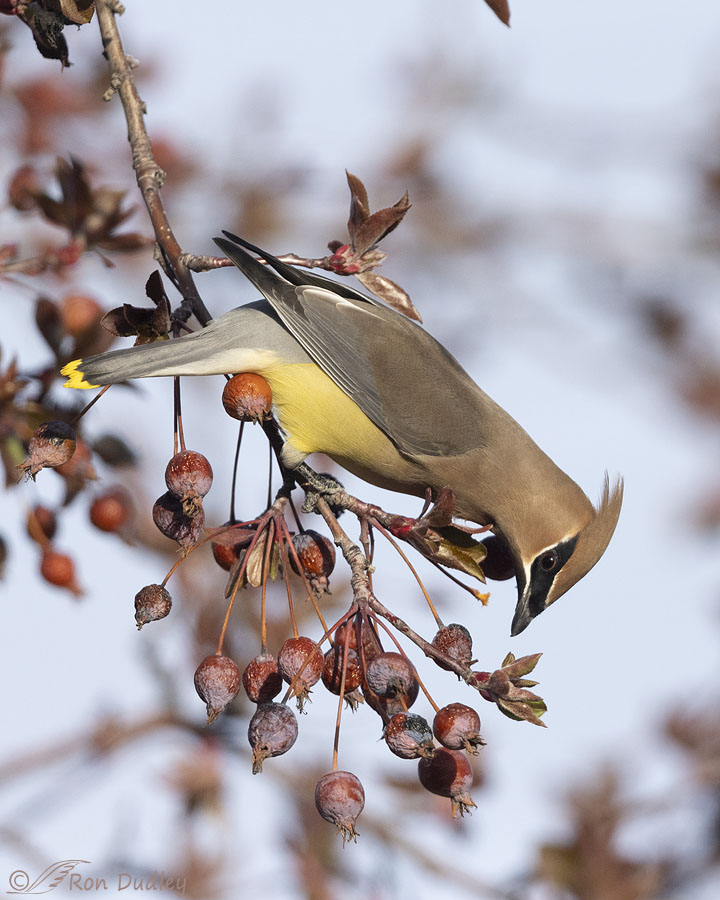
This young waxwing had a smorgasbord of crabapples to choose from and I was immediately excited to see that I might get some acrobatic poses out of the bird as ‘he’ tried to reach one of them.
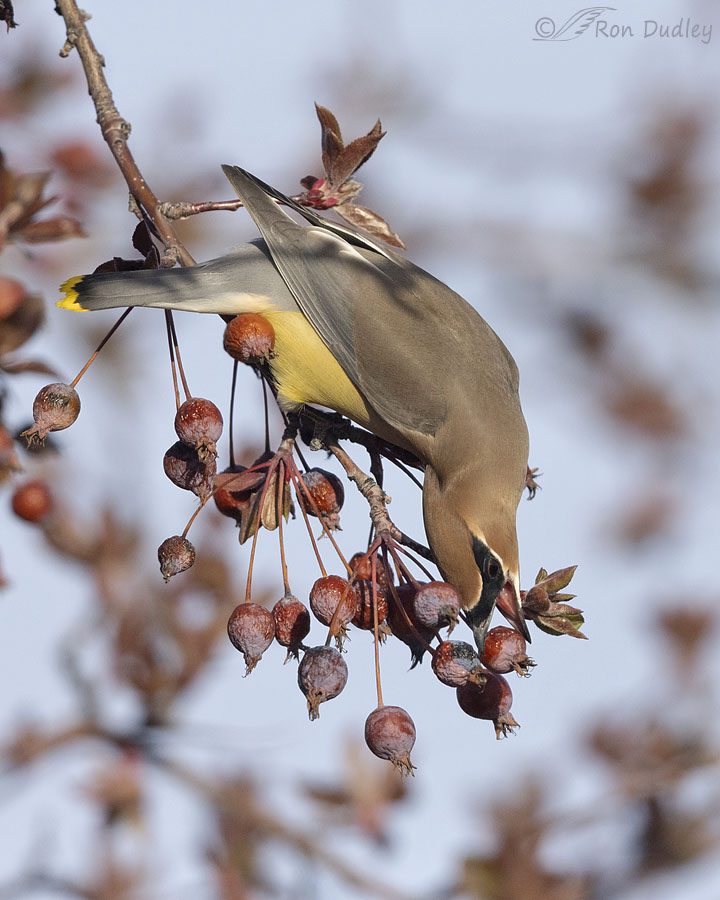
I did, but too bad I didn’t get a better catch light in his eye.
Actually, it turned out that he was only testing this crabapple. He ended up…
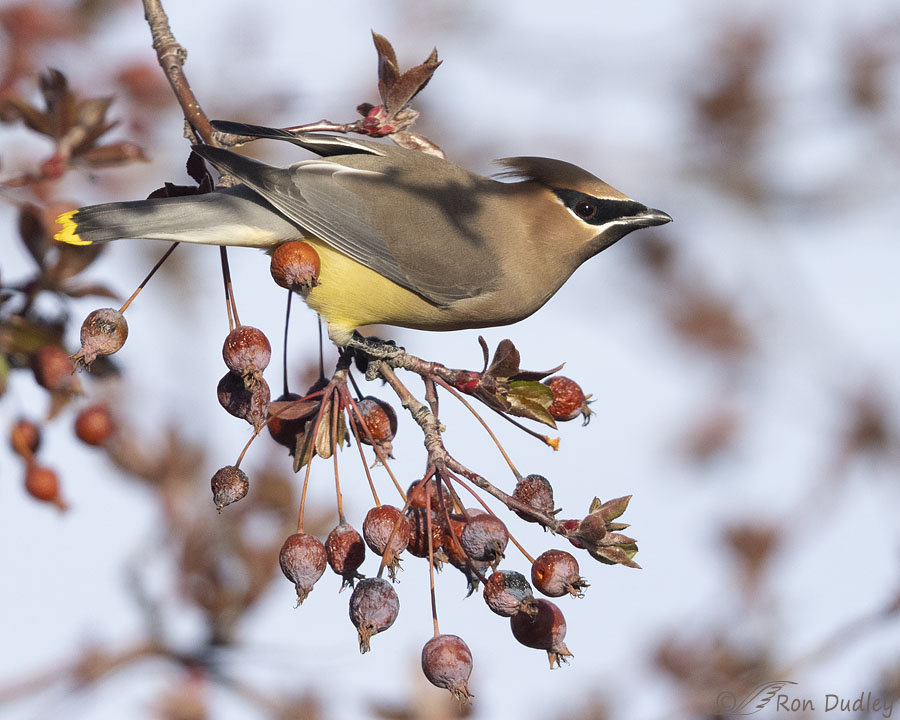
leaving it behind, perhaps because he realized it was too plump to swallow. I like the photo, despite the shadow on his back.
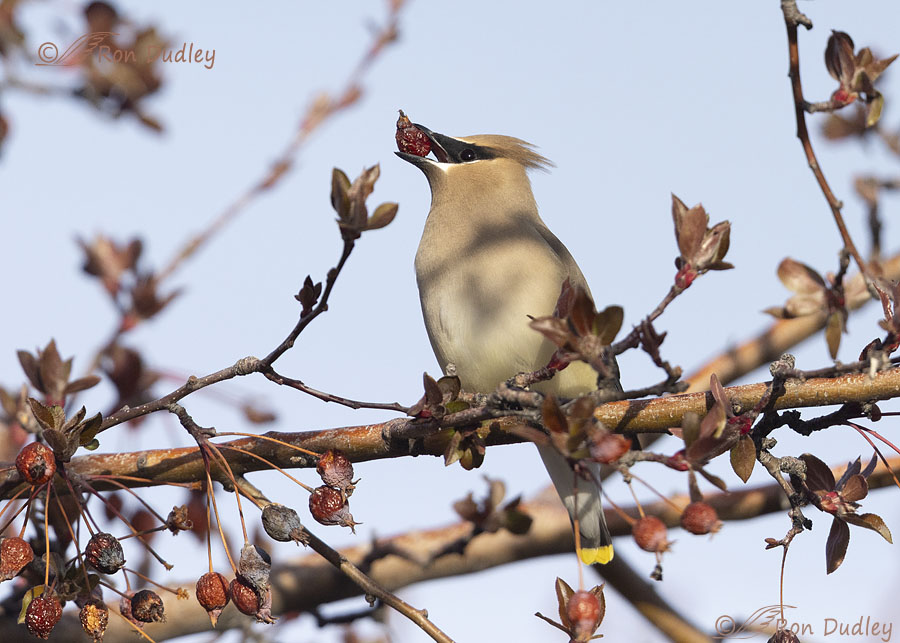
The desiccated and wrinkled crabapple in this bird’s mouth is typical of the ones that were easy to swallow but I had the impression that…
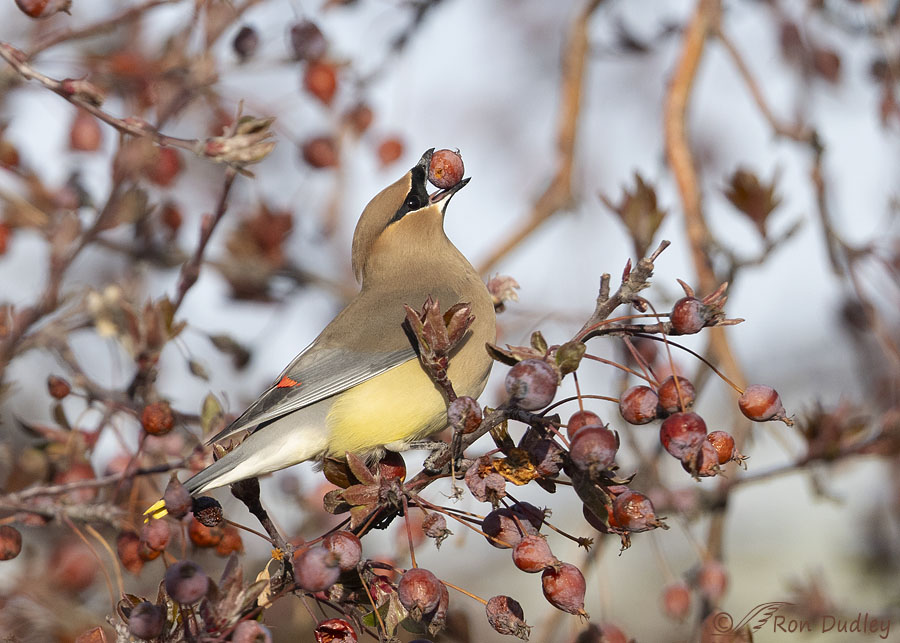
the waxwings preferred the plump berries if they could get them down. They often couldn’t.
This bird, one of the few adults I noticed, made many attempts to swallow this fat fruit and failed. You’d think that at his age he’d know better than to even try. In the end ‘he’ disdainfully…
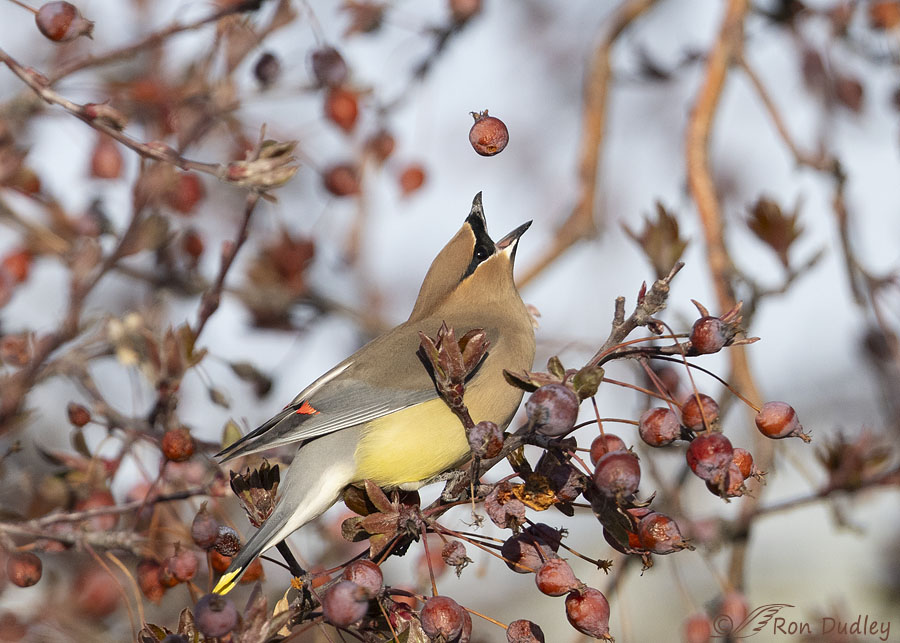
tossed the fruit up…
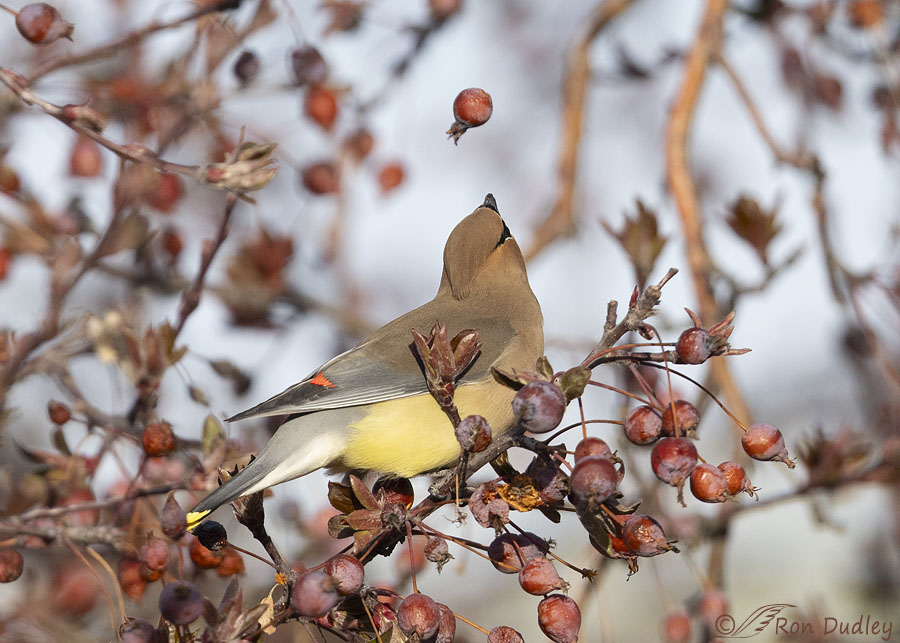
and away from him, letting it fall to the ground without making any attempt to catch it.
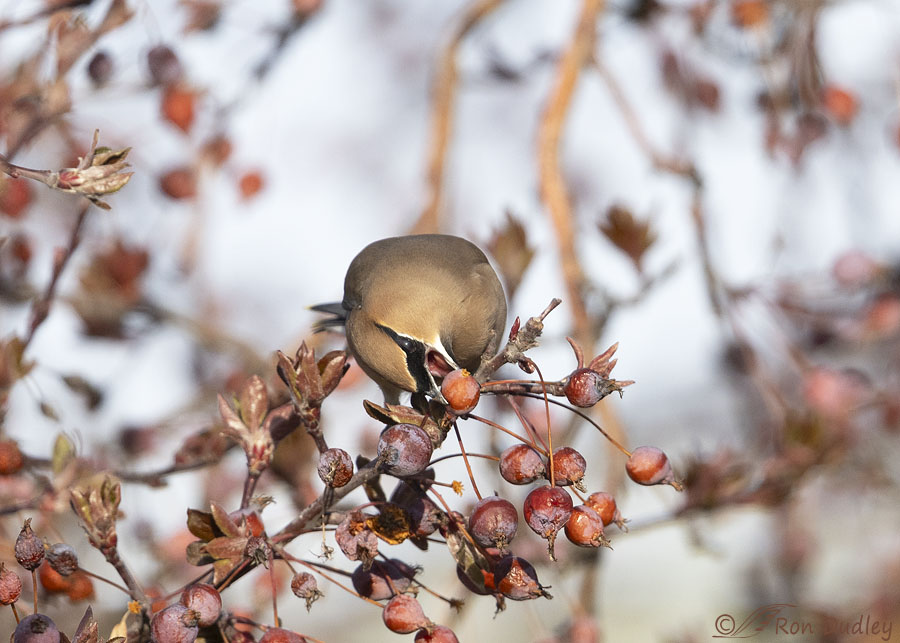
And he wasn’t a quick learner. He immediately leaned over and plucked another plump fruit which he tried to swallow for…
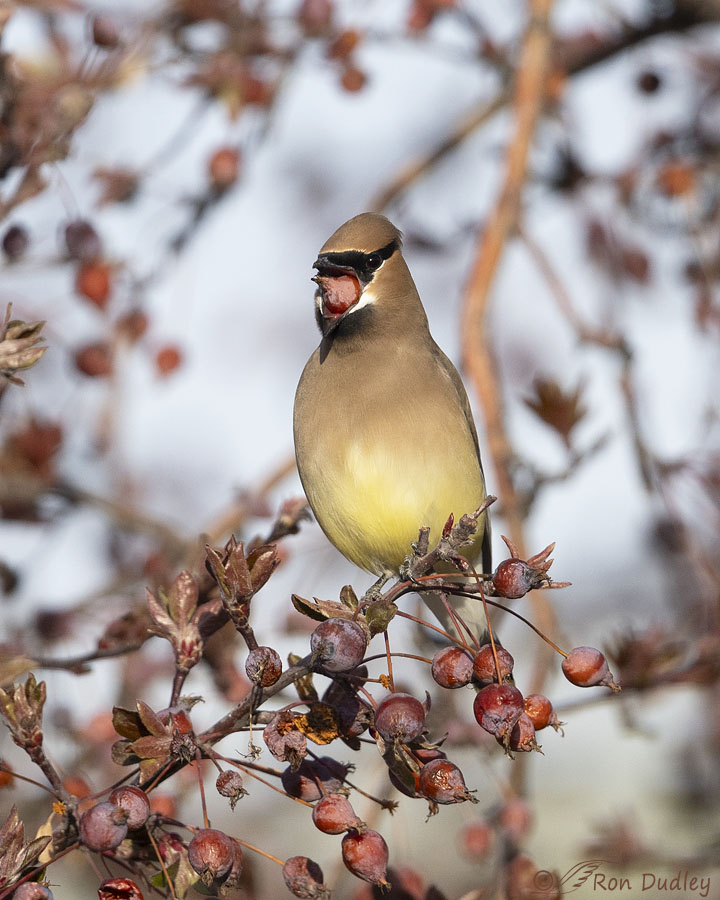
a very long time. So long that I ended up taking 139 photos of him trying to swallow it.
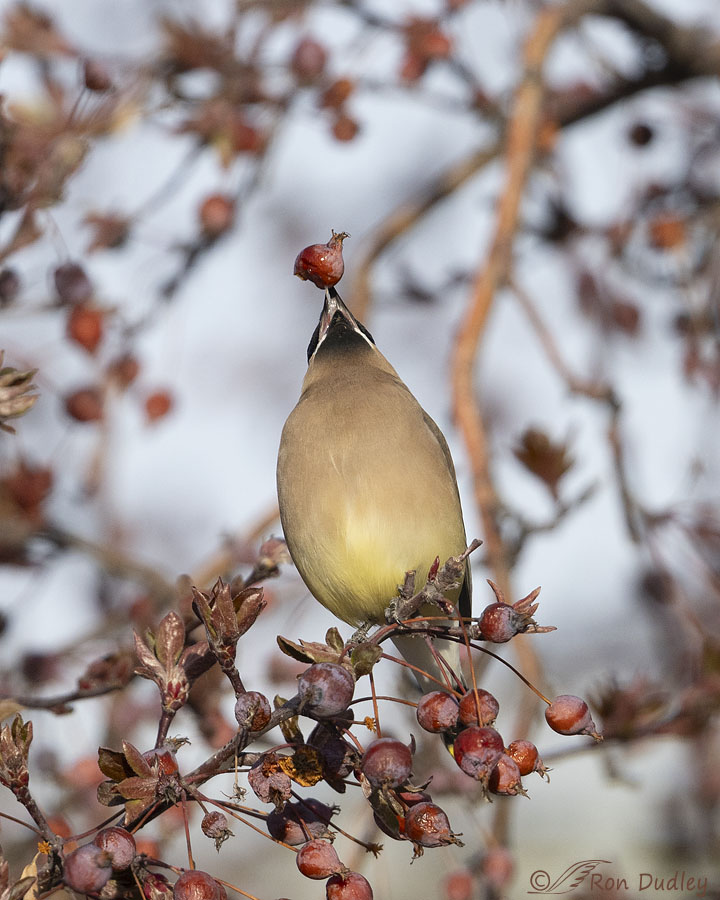
He tossed it in the air multiple times and…
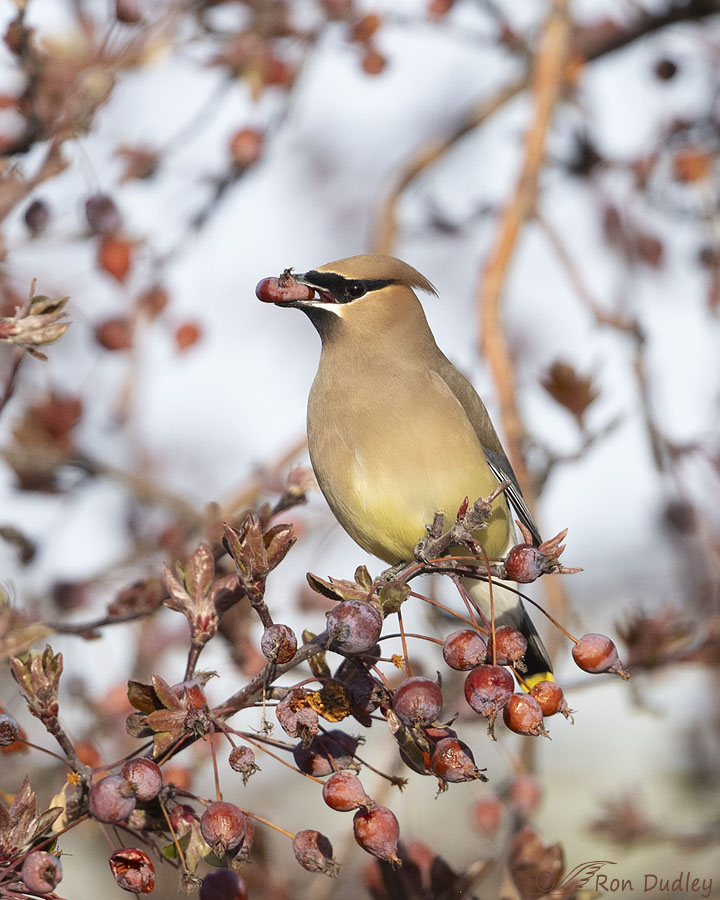
tried to mash it to a smaller size repeatedly, with no luck at all.
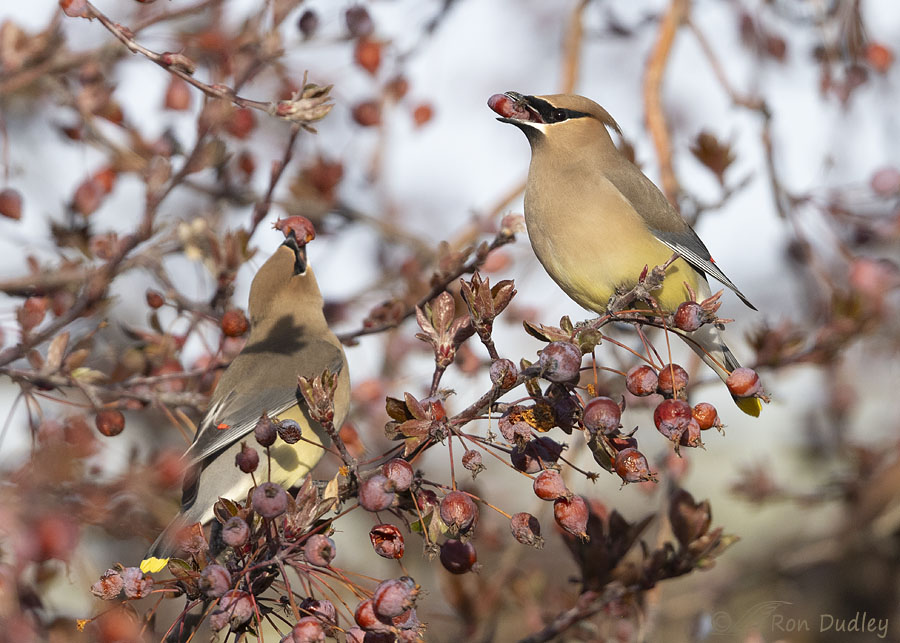
Soon another adult waxwing appeared, apparently to show him how it’s done.
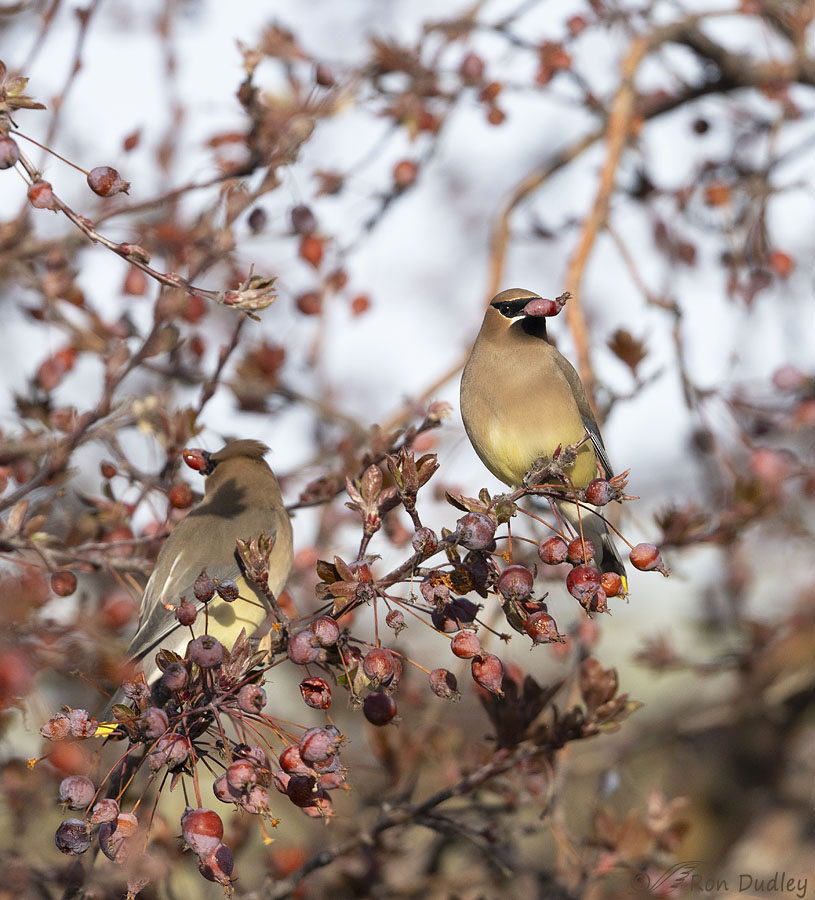
But as far as I could tell, neither bird was able to swallow their chosen crabapple. This photo has kind of a wonky composition because I wanted to include the upper right-hand corner for a reason.
When the original waxwing, the one on the right, took off the stubborn bird…
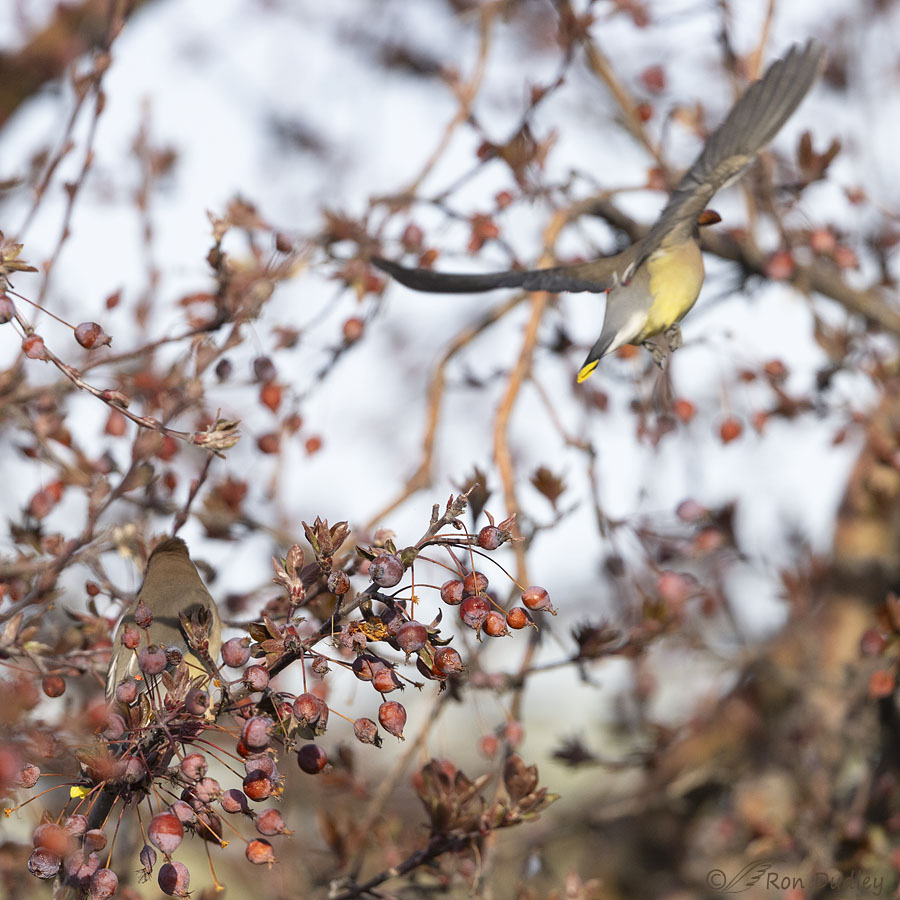
took off with the crabapple still in his mouth. We can see the fruit in his mouth but we can’t see his head or his bill.
All in all it was a challenging and fun session with the waxwings. Until that day I’d only seen two Cedar Waxwings all winter.
Ron
What a lovely series! Thank you!
Great series, I have yet to get an opportunity to shoot these beautiful birds
Great story line – and photos. I would still frame the first one you sent!! THANKS!
Thanks, Judy. I like that one too.
Fun series with great photos! I actually really like your “wonky” composition image with the two birds facing different directions, crabapples in mouth and lots of colorful foliage around them.
Good to know the back is holding up for now … 😊
Thanks, Chris. Regarding my back, I never know from day to day what surprises it’ll have for me.
Outstanding Ron. Excellent photos. We get them every year in a large flock that cleans out our large pyracantha shrubs along with any trees with berries. I have taken many photos but none as good as
yours. Great job.
Thanks, Everett. I think I still have scars on my hands and arms from the pyracantha I used to have in my yard.
Great series, nice images, thanks for processing and posting. When I ran into all the waxwings in St George there were very few with red tips. I often wonder if they break off and new feathers with new tips have not grown in yet. The red tip is only held on with the thin vein in the feather.
How did your eye detection auto focus do on the black eye and mask? I had a bit of trouble at times, I thought it might be due to lack of contrast on the eye.
Lastly, I have watched waxwings eating and they do tend to swallow fruits whole, but there are some ornamental plums in my area that are way too big to swallow, the waxwings seem to smash them with their beak and use their tongue to pull and suck out the pulp, discarding the skins and bulk of the plum. Did they do that with the large crab apples or are they too firm?
Thanks, April. Actually, my eye detection AF worked remarkably well on the waxwings most of the time. There were so many obstructions (twigs, leaves and fruits) in front of them I was pleasantly surprised by how well. The black eye and mask didn’t seem to cause a problem with it.
I didn’t notice any of these waxwings biting or tearing into the fruits to get at the flesh. The House Finches are another story – they tear into them all the time and rip them apart, swallowing just bits of fruit at a time..
Ron, this was a truly enjoyable series! Your narrative had me smiling and looking forward to the next picture! Thank you so much!
Thanks for the positive feedback on my narrative, Karen.
Smiling the whole time I was reading this at work.
I love how slim and elegant birds can look and then how cute and puffy they get when they’re gobbling down food, like this Waxwing who bit off more than he could chew. ^_^
Thanks, Amy. Smiles are always a good thing, especially at work.
What a great compendium of behaviors, not to mention gorgeous photos of gorgeous birds! The 139 images of “trying to swallow a too-big fruit” must be a hoot. And interesting that even with mashing them, they are too big. The details of their mouth structures are amazing. Thank you!
“The 139 images of “trying to swallow a too-big fruit” must be a hoot.”
They are, Carolyn – at least many of them are. I had a hard time trying to decide which ones to post.
“Dandy” is the perfect description for this series, Ron! Thanks so much for taking the time and the effects on your back to share this delightful morning with all of us. Hope you can rest your back for a while. 💕
Thank you, Marty. Back feels reasonably good so far today.
WOW! Wonderful series of a beautiful bird! I never thought about “size” of the fruit being an issue for them – appears they won’t “nick at them” to eat as opposed to swallowing them whole. Of course, I’ve never seen them feeding on the ground either which might explain that. I was also not aware the the immatures didn’t have the red “wax” tips on their secondaries. Noticed it but figured it was a male/female thing. Always something to learn! 🙂
“Noticed it but figured it was a male/female thing.”
Judy, there’s very little difference between the sexes. Occasionally males can be distinguished from females by their more extensive and slightly darker black chin-patch but it’s a very subtle difference.
What a wonderful gallery. I wish I saw these birds more often. They’re in my area, but prefer more wooded areas; our coastal plain doesn’t offer much to them, except when the occasional palm or mulberry produces fruit.
Shoreacres, during breeding season I see them in the mountains. Several years ago I knew where a nest was but it was mostly hidden so decent photos were nearly impossible to get.
They make me laugh. I love that first acrobatic pose. I just saw pictures of the Bohemian Waxwing. I’d never seen one before.
Arwen, I don’t remember ever seeing a Bohemian Waxwing.