

Drama in my backyard.
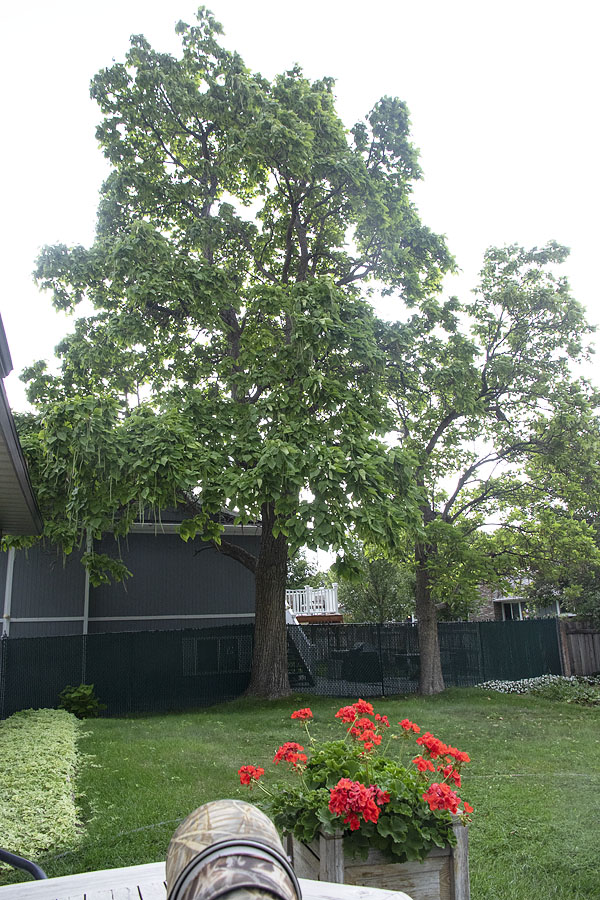
Two days ago in the evening I was sitting at my patio table when I saw a Cooper’s Hawk fly in and land near the top of my largest catalpa tree. At the time I assumed it was my old friend Hannibal, the juvenile Cooper’s Hawk that pays an almost daily visit to my yard to hunt songbirds at my feeders.
The hawk was in the densest part of the tree, up high, where I couldn’t see it, but it could see…
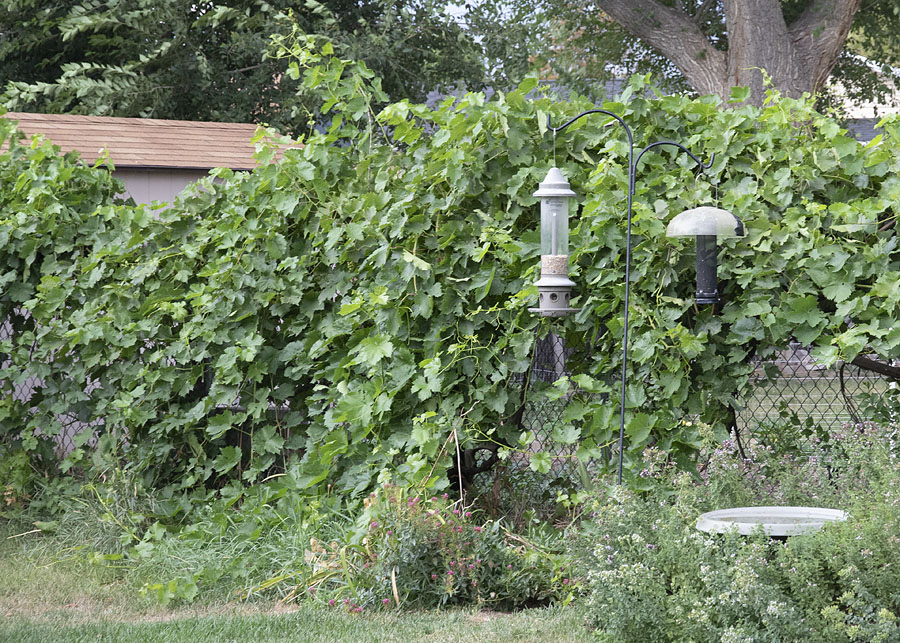
my feeders (behind me) and the thick grape vine directly behind them, where birds often hide from any marauding hawks.
My friend and neighbor Shane was in his backyard too, so I texted him, telling him about the hawk in my tree (Shane is a bird photographer too).
Notice the notch or low spot at the top of the vine to the left. Normally Shane and I can only see the tops of each other’s heads when we try to talk to each other through the vine, so we trim that spot lower which enables us to see more of each other’s heads. We call that spot in the vine a “Wilson Window”, in honor of Tim and Wilson from the 90’s TV show Home Improvement (Shane is Tim and I’m Wilson).
After texting Shane I went back to watching my feeders in anticipation of an attack from the hawk in my tree. The attack occurred but the hawk wasn’t Hannibal and it wasn’t after a songbird.
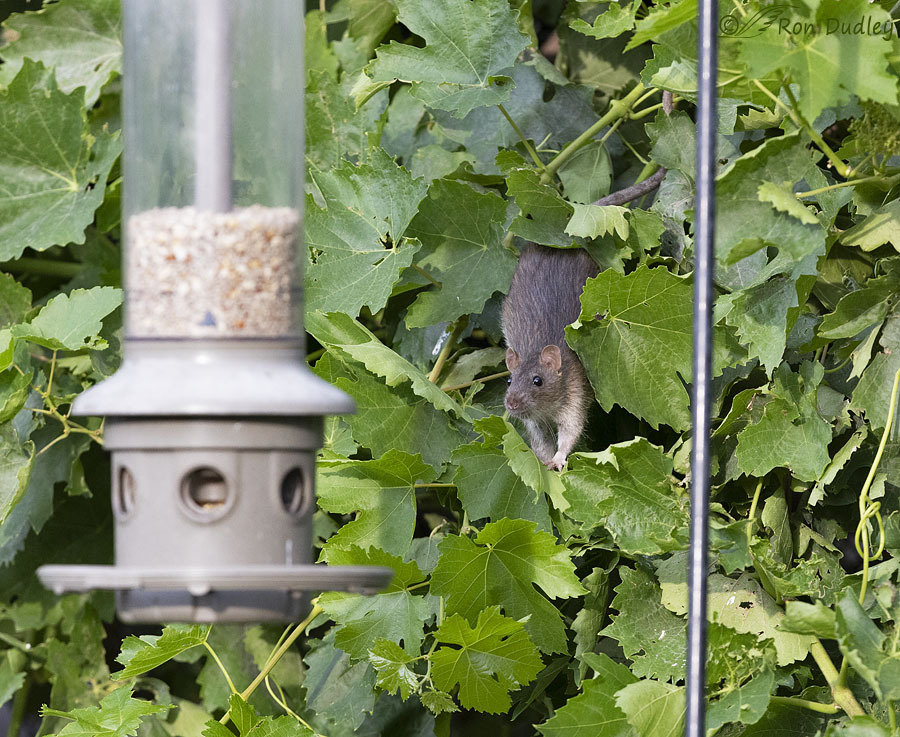
Suddenly I noticed a rat in my grape vine and it was trying to jump from the vine to my feeders. Occasionally I see a rat beneath my feeders, scrounging bird seed that has fallen to the ground, but this was the first time I’d ever seen one in my vine. This guy was nearly 4′ off the ground.
First ‘he’ tried to figure out a way to jump to this feeder. When that didn’t work he…
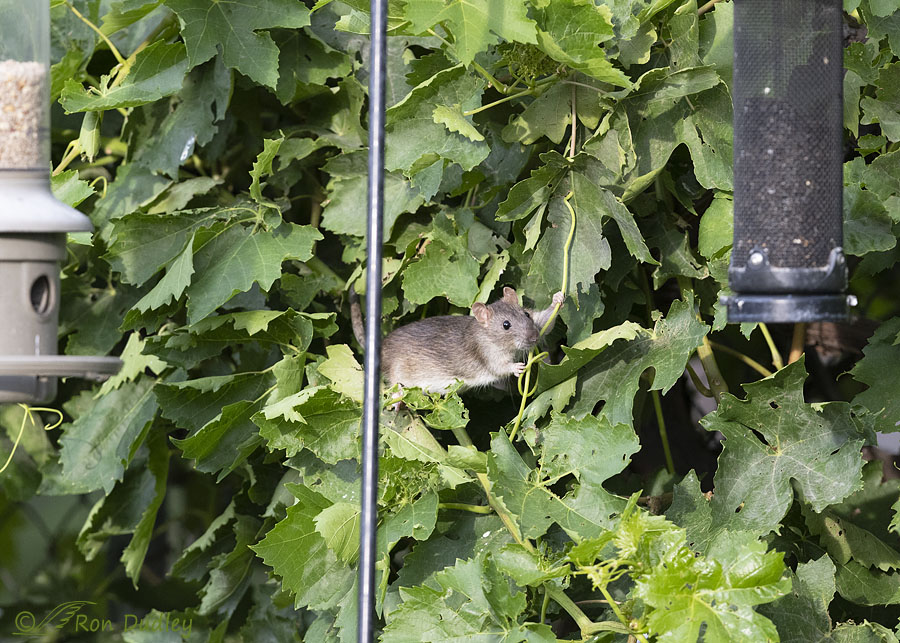
tried the other feeder. That didn’t work either – the vines were to “springy” to allow him to push off. They barely supported his weight.
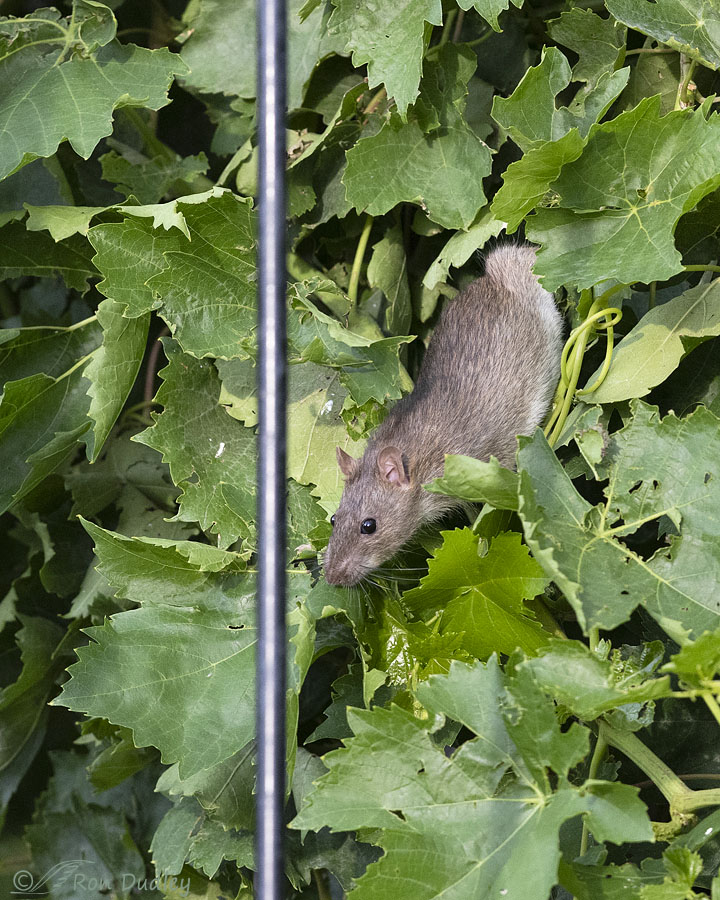
So next he tried to jump to the pole supporting the feeders. That also didn’t work.
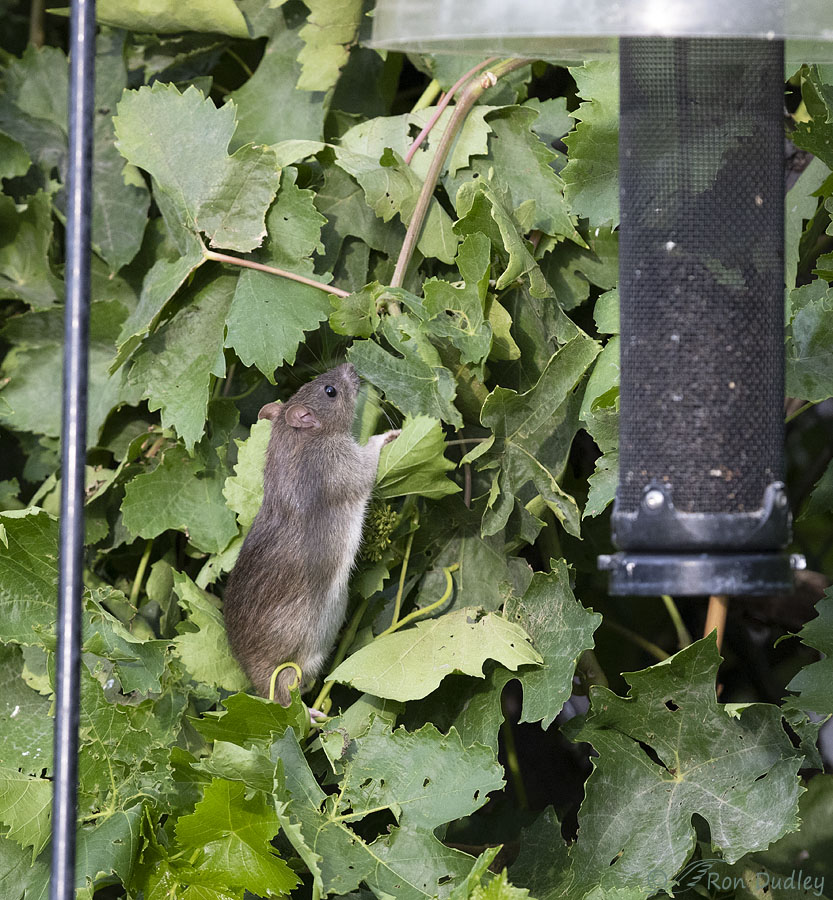
This is the last look I had of him before the hawk swooped down from the tree and made its attack.
The rat saw the hawk coming and disappeared in the vine. The hawk swooped over the vine and landed on it right next to Wilson’s Window, on Shane’s side of the vine where I couldn’t see it (Shane told me where it was).
At that point I figured I’d seen the last of the hawk, but I was wrong. That persistent bird wasn’t ready to give up on the rat so it came back to my side of the grape vine and…
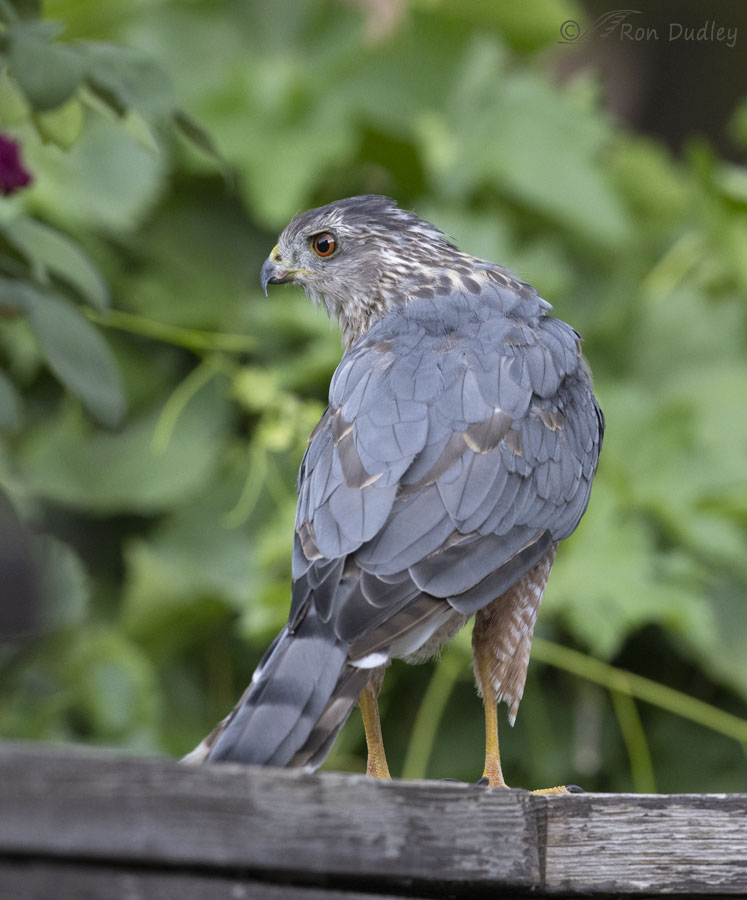
landed very close to me on the top railing of my old deck, where it could scan the entire length of the vine for the rat or anything else that looked appetizing.
As I said before, this is not Hannibal. Hannibal is a juvenile but this bird is transitioning into adult plumage. Based on size I suspect this Coop is a female.
When she couldn’t spot the rat from this vantage point she…
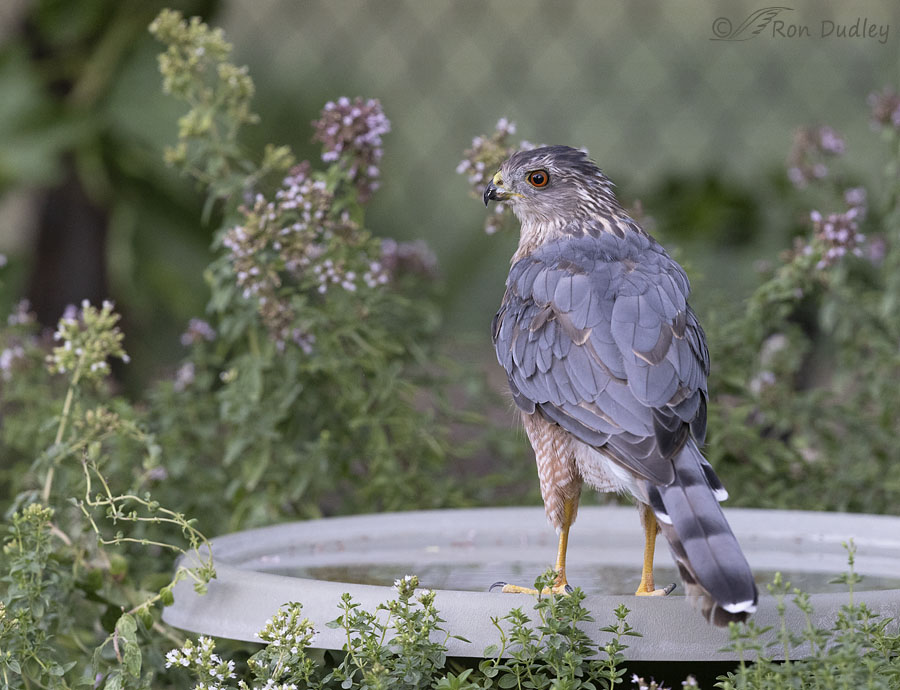
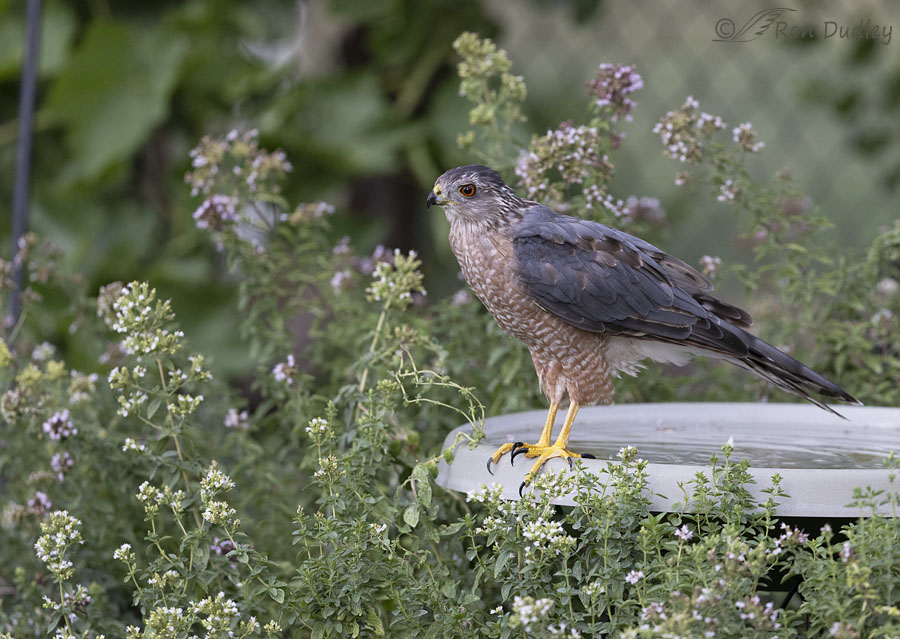
flew down to my bird bath for a drink. Notice that her bill is wet.
From here she flew almost straight up a few feet to…
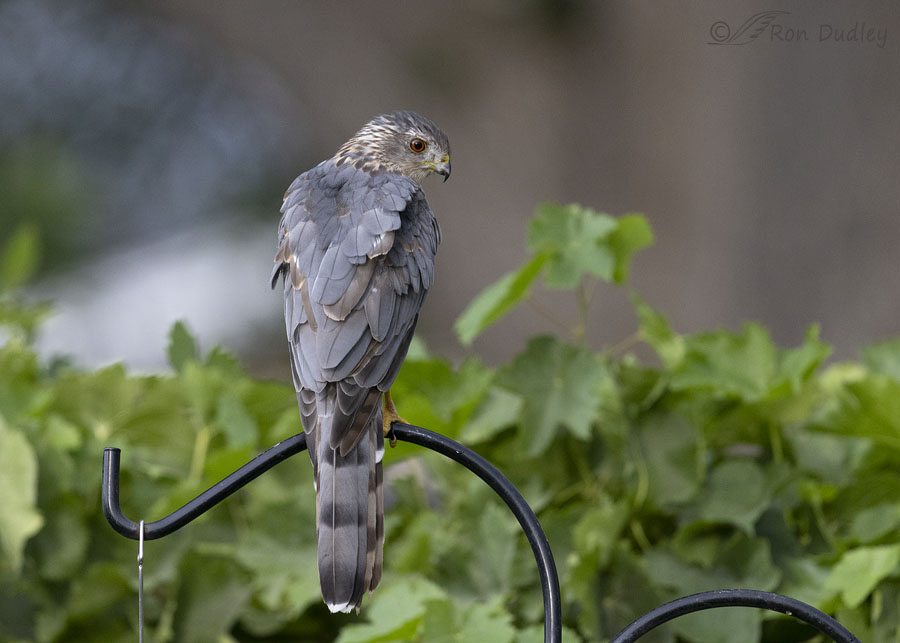
the top of my feeder pole. She kept looking for that rat in the vine. When she couldn’t see it from this side of the vine she…
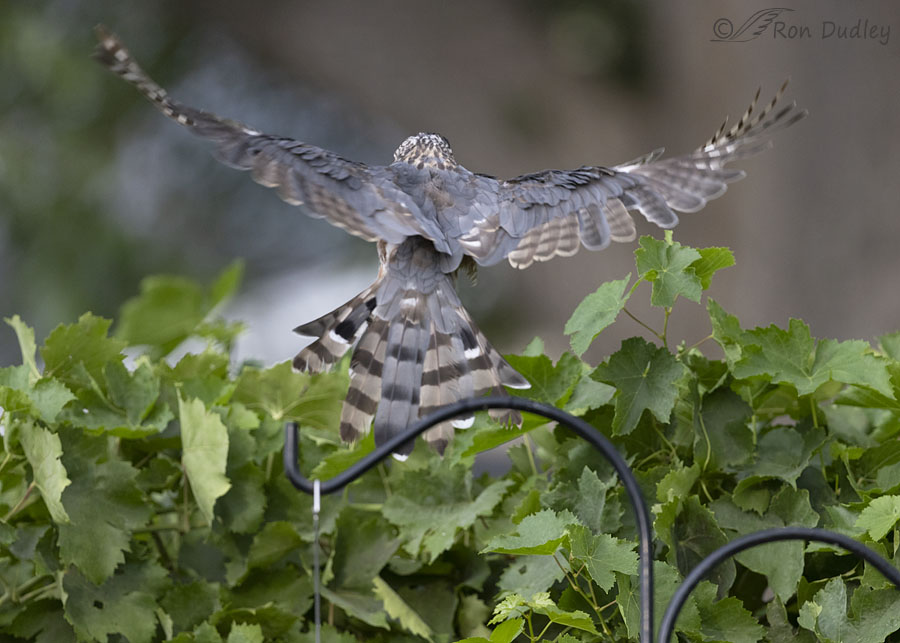
flew back to Shane’s side.
This shot isn’t very sharp but it gives us a good look at the differences between her remaining juvenile plumage (brown feathers) and her new adult plumage (grayish-black feathers).
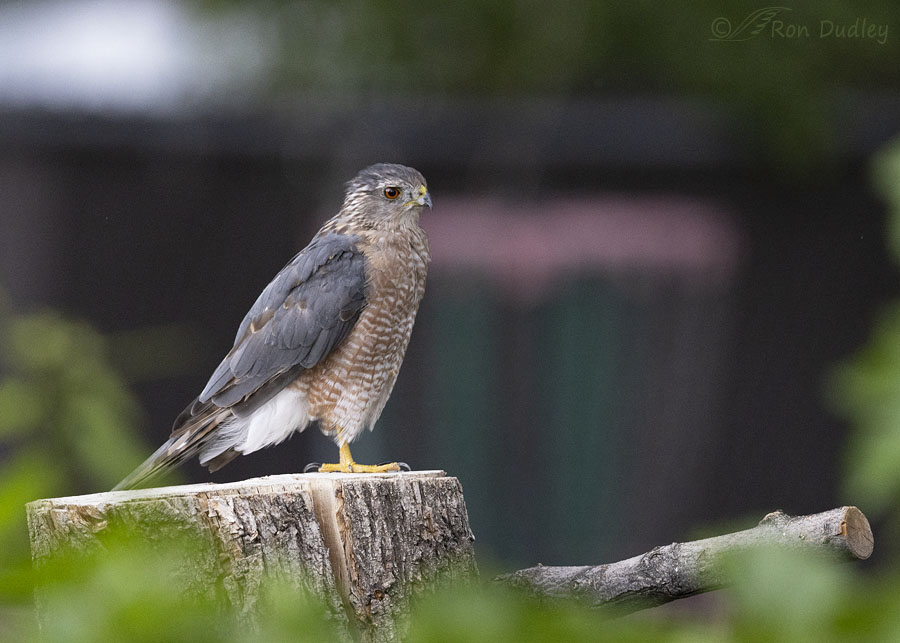
The last I saw of her she was still looking for the rat from an old stump in Shane’s yard. The out-of-focus greenery at bottom is the top of the grape vine.
But Rattus disappearus made his getaway safely. Time to dig out one of my rat traps.
Ron
Note: Cooper’s Hawks are best known for eating songbirds but they’ll kill and eat rodents, including rats, when the opportunity arises.
Now that is one heck of a story with images! Many thanks.
Ron, ‘m still kicking at 90!!
What a super series!!! Better than tv!!!
The Gill Tract farm (volunteers do the labor, fruits and veggies go to low-income families, University of California pays the water bill, and it’s next to the Sogorea Te’ land tract, which has a stream which makes it *the* native habitat of the Pipevine Swallowtail butterfly), is on a busy corner of Marin and San Pablo, in Albany, Ca and it has a gopher problem!!
I don’t know how they can attract raptors… I know there are raptors in the vicinity… it’s quite close to the freeway and the red tailed hawks sit on the light poles over the freeway…
But… no luck… not a lot of tree cover
Bandito probably blabbed to Mr. Rat of the fine cuisine to be found in your yard (he was supposed to keep it a secret!).🤐
An exciting tale for sure, Ron. I was rooting for both animals, to be honest. Had a rat in the garage a few years ago that was pretty danged smart. I never ended up catching him, regardless of the type of trap I set. It was very humbling to be bested by a rodent.
Marty, every rat I’ve ever dealt with seemed “pretty danged smart”. And sneaky. And quick. A combination that makes them a worthy adversary.
Oh what a wonderful story! thank you for sharing–I also love your “window”1
Thanks, Laura.
I know, I know… I don’t want rats around my place either, but I must say it was interesting to watch this one engage in a little problem solving. Of course the hawk was doing the same thing. It turned into a draw this time, but if the hawk doesn’t get it in the future, I hope you do!
“if the hawk doesn’t get it in the future, I hope you do!”
Shoreacres, if I don’t it won’t be for lack of trying.
Wonderful post, Ron. Like Michael, I really appreciate seeing the transition in the Coop’s plumage. My eyes don’t usually pick that up when following the action in the field, but your camera captured it beautifully. Thank for sharing!
I often miss it in the field too, Diane. In that way, photos come in real handy.
Interesting as usual. I was hoping the hawk would engage the rat – and win! Do NOT like rats. Maybe your trap will get it.
Thanks -as always – for sharing.
Thanks, Judy. I REALLY enjoyed talking to you tonight. We should do it more often.
Fun pictures. So much excitement in your back yard and you got to share with your neighbor. I love that you have trimmed the grape vines so you two can see each other and have named it Wilson’s Window and have each taken the names. 😃
Laurie, Shane’s a great neighbor. The kind everyone should have.
Very neat that you got to see all that play out. I’m a falconer and I love that my birds allow me to interact with them during a hunt. I use long haired miniature doxies to jump the rabbits and then, game on. You take beautiful pictures which is something I can’t do. Action shots are impossible for me.
“You take beautiful pictures which is something I can’t do.”
Much appreciated, Mick. It takes lots of practice. And the right camera gear of course.
A great documentary, Ron!
Thanks, Bill.
Excellent documentation of an exciting story – loved seeing both these critters in action!
Thank you, Sam.
As much as I hate rats in my yard or in my house (and several years ago I had *both*), I’m like Susan who saw that “kinda cute” critter and kinda hoped this wouldn’t end as I was fully expecting it to. Surely she’ll return for another try and your trap will be unnecessary. 🤞
A couple of summers ago, I did watch with delight as a Coop swooped down from the neighbor’s sycamore and snatched one very large, long-tailed rat from the shrubs right behind my boulder fountain. Believe me, I cheered that hawk on, begging him/her to come back for more. Far better rats than warblers or finches! 😬
“Surely she’ll return for another try and your trap will be unnecessary.”
I hope so, Chris. But the rat is still there as of a few minutes ago. I took three shots at it with my slingshot (ball bearing ammo) but missed all three times. I came close but no cigar.
Nature up in your face! lol. The story made this post, professor.
Glad you liked the story, Arwen. Thanks.
A most educational and amusing post, a view into the perspective of the main characters.
Thanks, Eloise.
Thanks Ron! Beautiful pictures of a beautiful hawk.
Thank you, Carol.
How fun! I am team no rats so was rooting for the hawk. 😀 Had mice in our mountain house last year. As soon as I saw their existence it was dooms day followed by basement fortification. No more! When working on the basement found proof a skunk had tried to move in. Coexisting with nature is lovely – but not ‘in’ my house. That is a suicide mission 😹.
Kathleen, I know from experience that skunks can really make life miserable for humans. I still like skunks, but not rats.
What a gorgeous bird! The intensity of her look in the first photo – not someone you want to mess with!
Thanks to Michael McNamara for verbalizing the color difference in her tail – I noticed it, but couldn’t figure out exactly what I was seeing.
And very glad your grape vine is so dense – for the birds and the ratty. (Sometimes I like to pretend the food chain doesn’t exist!)
Thanks, Carolyn. Michael has a penchant for making insightful comments.
Funny story and good photos Ron. When you don’t have a restaurant or Starbucks to go to in the morning for a bite to eat you will work for as long as it take to track down some prey. I have watched hawks and other predators at work and they just will not give up. Just watch a Heron or Egret that has caught a giant catfish that takes them a couple hours to lift and get down and they never give up.
Thanks, Everett. Yup, birds are persistent. They have to be.
She’s a beautiful bird ! A little sorry for the rat, but I wish the Cooper’s
good luck– she’ll be feeding a family soon– and we need all of the flying rat-traps we can get.. I love seeing your backyard– it’s really
luscious……..
“I love seeing your backyard– it’s really luscious.”
Thanks, Kris but don’t look too closely. Some of it looks a lot better than the rest.
What a cool post! So enjoy these posts that are photos with a story, and it being a Coops makes it all the better. Also really appreciate that this bird was in transition. Don’t see too many Coops photos that illustrate this phase. Of particular interest in your second to last photo is that it shows how the two ‘deck’ feathers (middle tail feathers) are typically the first of the tail feathers to molt.
Really enjoyed this one!
Note: There has been one occasion where I have seen an urban Coop feeding on rat.
Thanks very much, Michael. I first noticed the transitional plumage on this Coop about 6 weeks ago. It’s been fun to watch (and document with photos) the process developing.
Yes, I love that photo too. The new mixed in with the old. Great shot Ron.
Thank you, Buz.
I confess I was rooting for the rat to escape because as soon as I saw the first photo of the rat (who is kinda cute, I must admit) I was anticipating another dead rat photo, so I was very happy to escape what would surely have been the “piece de resistance” for most everyone else.
Fun series!
Thanks, Sue. I used to have sympathy for rats, especially after reading Stephen Gilbert’s book Ratman’s Notebooks many years ago. I no longer have that sympathy.
Great sequence, Ron! 🙂 Too bad the hawk didn’t connect – I’m sure the rat is on notice now……. Also glad we only have pack rats to deal with and, fortunately, I haven’t had to deal with any for several years now!
Thanks, Judy. At least I don’t have pack rats. This bug-eyed bozo’s days are numbered!
Beautiful group of photos (as usual) and a nice adventure story to boot!! Thanks!
Thank you, Joanne.