

These days I rarely publish posts to my blog on consecutive days, but today’s post is an extension of yesterday’s.
Only seconds after I took my last photo of the Woodhouse’s Scrub Jay that I published photos of yesterday, I spotted a male California Quail running across my lawn toward the grapevine growing on the fence on the east side of my yard.
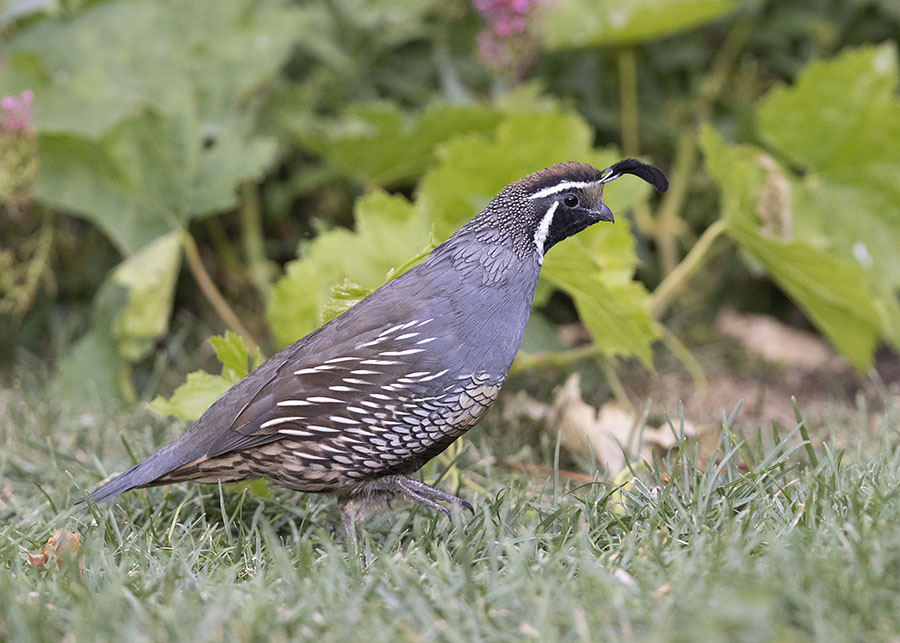
He was in a hurry, so I had to catch him in mid-stride. But suddenly he…
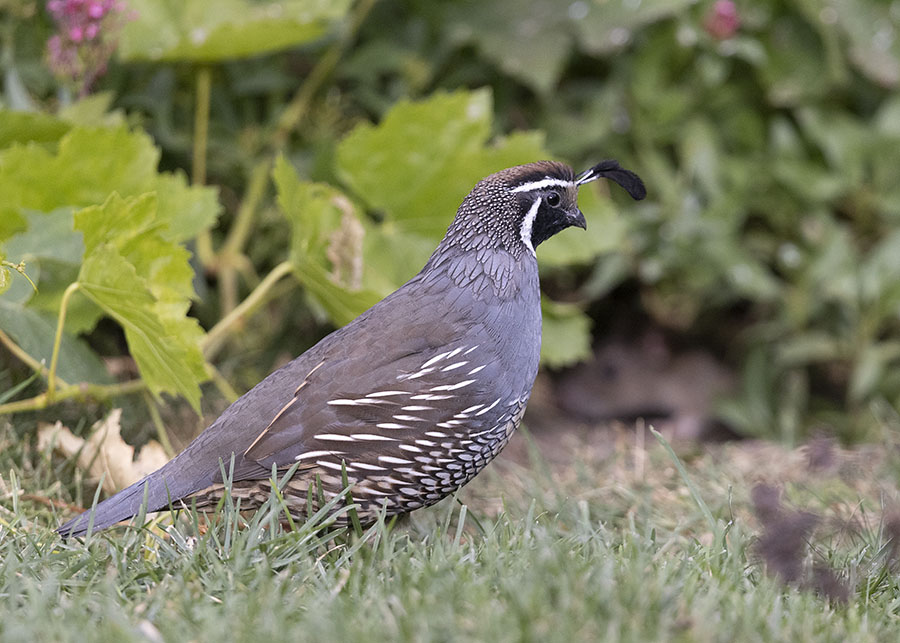
stopped and froze, holding this position and posture for a very long time. Look closely and you’ll see why.
In the background, right in front of his upper breast, is a rat peering back at him. I didn’t have enough depth of field to get them both sharp, but they were quite close to each other – only a few inches apart. They stared at each other for almost a full minute without moving, which is a very long time in the bird world.
And that gave me much more time than I needed to…
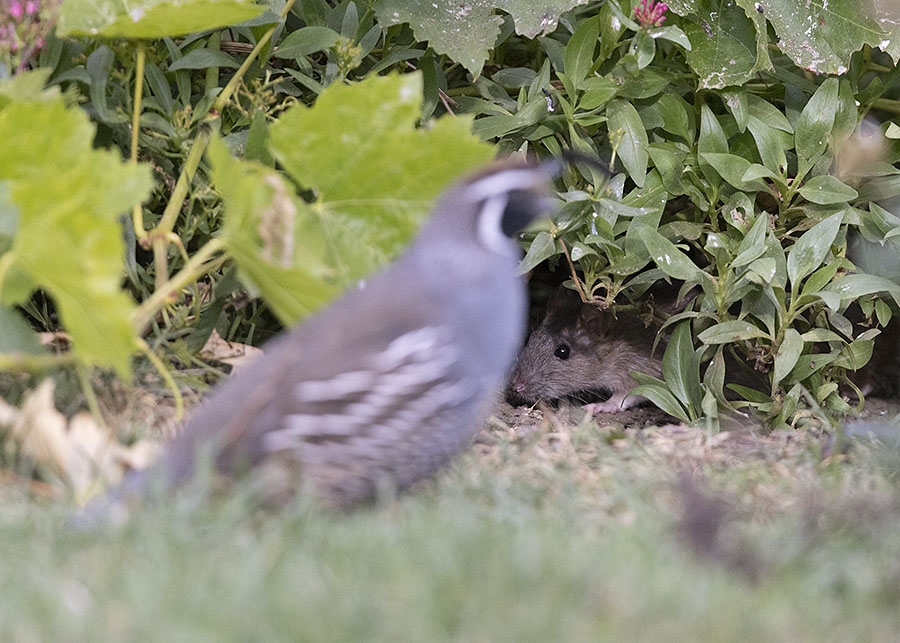
train my active focus point on the rat. Eventually, after a very long mutual stare-down, the rat withdrew back into the shadows and the quail proceeded on his way, cautiously.
Not my typical blog post but the encounter and the photos amused me, so I decided to share. At least something good and interesting can result from the presence of a %@#! rat.
Ron
LOVED you squirrel episode. We had lots of black squirrels in Omaha and loved watching them – and their little ones. The squirrels in Bountiful would often dig tunnels in the ground – and leave the evidence. Then we would see them come up and stand with their tail arched as if to challenge us to catch them. Also watched porcupines, deer, racoons (going down chimneys to build their nests) and other critters – including lots o beautiful colored birds (until the magpies arrived). Your work is SO ENTERTAINING! THANKS!!
Wow! Nice pics. I appreciate you posting these. I’ve never seen a quail. Beautiful bird.
WOW! Glad the quail became aware of the rat and the rat didn’t try to “take” the Quail! Other than that a very nice visitor to have in your yard!
Judy, don’t think the rat tried to “take” the quail but after these photos were taken it did chase the quail off. I missed those photos though – it was very quick and I wasn’t prepared for it.
I wonder what they were thinking when they saw each other..!
We’ll never know…
As usual – VERY INTERESTING commentary. AND – the photos are great. With all the quails we had in Bountiful – I never saw one stand still – at all.
Thanks, Judy. This guy held so still for nearly a minute he almost looked like a statue.
I thought at first it was going to be quail/scrub jay confrontation!
I am always amazed when/how the quail freeze. In my yard, when the hawks are around, the quail, if they can’t run into the junipers in time, will freeze for 30 minutes or more – absolutely no movement, and totally quiet. The chickadees usually give the all clear, then one brave quail will cautiously start to peck the ground again, which releases the rest of the covey. So fascinating!
Carolyn, I’ll have to watch for that particular quail behavior. I’ve yet to see it. In that situation, my quail always seem to make a panicked escape from the area.
Thanks for sharing the quail and the rat. I have not seen either of those up close and it is a pleasure to see them, especially the quail. Well, the rat too as long as he’s in your yard I’m not mine.🤗
“Well, the rat too as long as he’s in your yard I’m not mine.”
I don’t blame you for that sentiment, Eloise. Tables turned, I’d feel the same way.
Well, rats! I hate the idea that you *could* have nesting quail in your yard but that furry little busterd [sic] would make a meal of the eggs. Nice pics of the bird, though. ☺️
Chris, besides being “busterds”, rats are voracious and opportunistic omnivores. Eggs would serve them just fine, as would baby birds.
Fascinating. The rat is an intelligent and clever creature. After the county here thinned the underbrush dramatically in my rural neighborhood, the Dusky-footed Woodrats moved into our barn. They are not house rats, ratus ratus, but are twice the size of mice and very clever.They learned our kitchen very quickly! And our dog, who is fierce against bears and such, doesn’t consider them worthy foes.
I’ve greatly enjoyed your “behavioral” photos of late. Thanks.
“I’ve greatly enjoyed your “behavioral” photos of late.”
Thanks very much, Sallie. When it comes to photography, I’m a “behavioral” kinda guy.
Interesting and unusual post. Keep ’em coming Ron. They make life more interesting.
“They make life more interesting.”
Good to know, Burrdoo. Thanks.
Would a rat eat the quail’s eggs?
In a heartbeat, Cheryl.
What an encounter. It is easy to see from the position of the vine leaf in the background that this encounter happened just a couple of strides after that first photo was taken.
“…which is a very long time in the bird world.” Indeed it is.
We have to take our bird feeder in at night because of rats. They seem to be able to climb up the half inch diameter metal bird feeder pole that we hang the feeder on. Do you have this problem, and if so, do you have some recommendation for a device or method to keep them from climbing up the pole? There seems to be a lot of things out on the market, but it is hard to tell which would be effective. So, I thought I would reach out to the professor who I am sure has experience with this. Thanks!
“do you have some recommendation for a device or method to keep them from climbing up the pole?”
Michael, check out this link from Wild Birds Unlimited.
https://order.wbu.com/shop/poles-baffles-hobby-products/poles-baffles-hobby-products/aps-squirrel-baffle/702
It’s a baffle for squirrels but I know from experience that it works perfectly for rats too. I have one on my cylinder feeder pole. I’ve watched rats try to climb the pole multiple times but they can never get past the baffle.
One time, to relieve some of my frustration with rats, I hit that steel baffle with a metal rod while a rat was actually inside the baffle (so it couldn’t see me sneaking up on it). That rat came out of the baffle like it was shot from a cannon. I still chuckle about it.
I rang his bell!
😂 Thanks for the info and the laugh.
The dramatic encounter brought a dramatist’s words to mind. Granted, they’re somewhat adapted, but they seem to fit: “”All the world’s a stage, / And all the creatures there merely players; / They have their exits and their entrances”.
Somewhere, the Bard’s words can fit almost any situation, can’t they Shoreacres.