

Four photos and three short video clips.
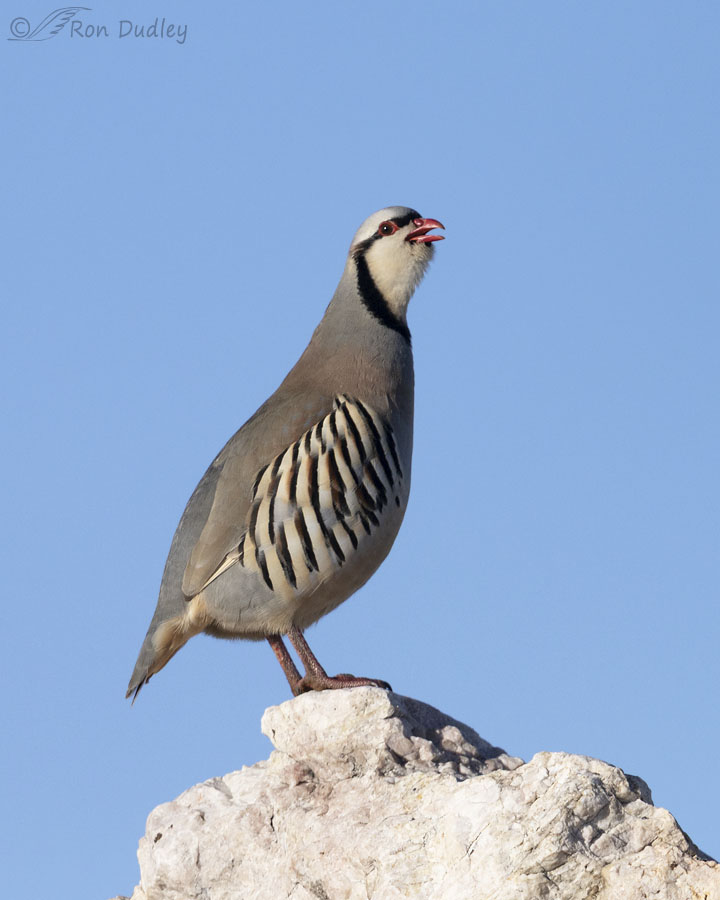
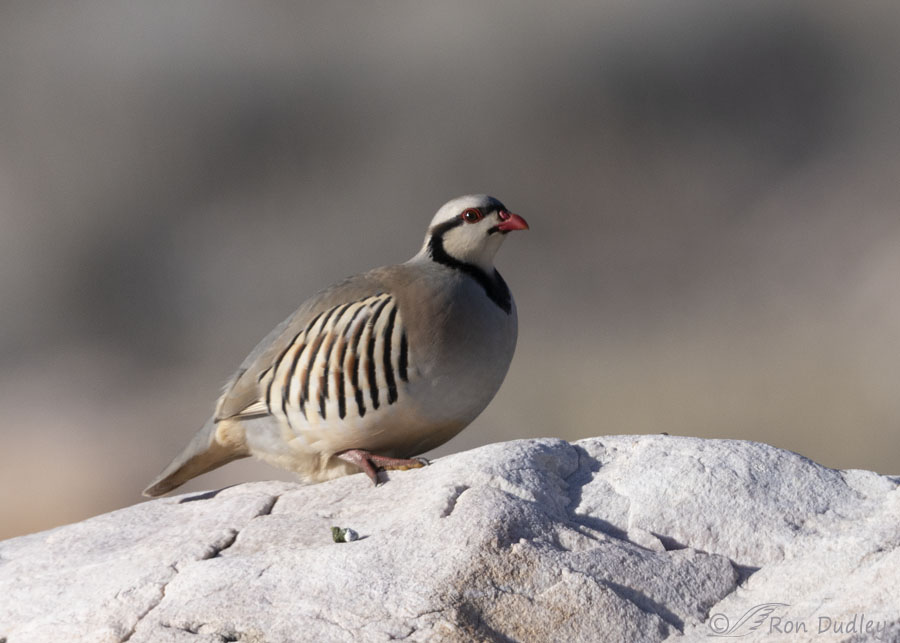
Four days ago the Chukars on Antelope Island were finally conspicuously active again. In one area of the island in particular many Chukars were calling to each other from elevated rocky perches, a behavior that makes them ‘stickier’ for the photographer.
I most definitely took advantage of their stickiness, even though I was having trouble with heat waves causing slight softness in my photos for much of the morning. That softness may be evident in some of today’s photos and video clips but I think they’re plenty sharp enough to document these behaviors.
Chukars are a vocal species. The Chukar above was exhibiting what’s called their “rally call”. Here’s what Cornell’s Birds of the World has to say about the rally call:
“Most common call and the one from which species derives it name. Commences as low-intensity chuck, chuck, chuck that changes to per-chuck, per-chuck as intensity increases. This in turn gives way to chukar-chukar-chukar, which with ever-increasing intensity and volume becomes 3-syllable chuckara-chuckara-chuckara . This call usually given from rocky vantage point and carries for great distances. Both sexes use this call. During summer, fall, and winter, when coveys are flushed, this call is the primary method used for locating one another. Function of this call during breeding season is primarily to space males rather than to attract a mate.”
Here’s what the rally call sounds and looks like.
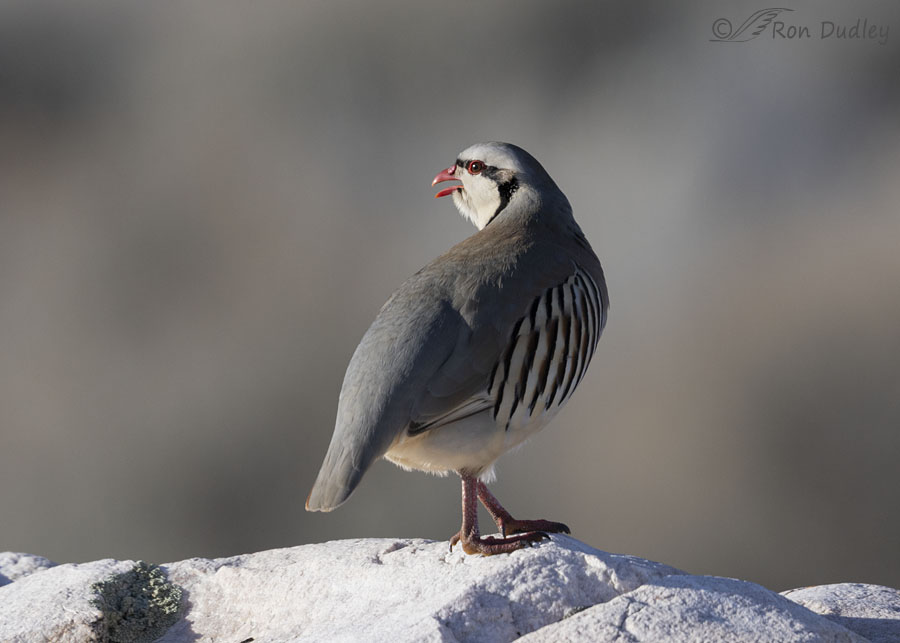
When I found this presumed male Chukar a few minutes later he was in harsh sidelight and calling toward two other noisy groups of faraway Chukars, one group out of frame to the left and the other group out of frame to the right.
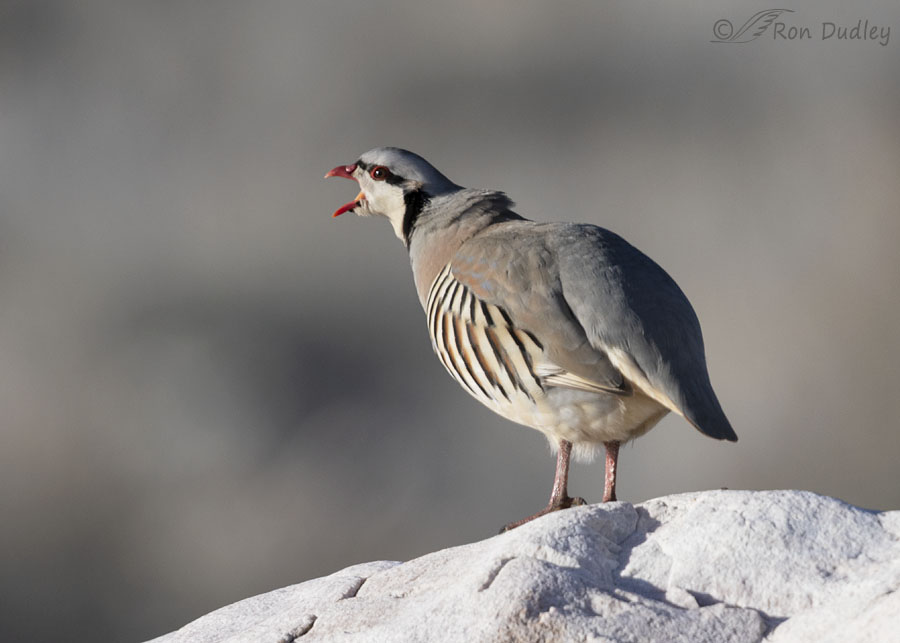
But then his behavior changed rather dramatically. He stopped calling and began to assume this aggressive posture toward the other Chukars, alternately facing the group on the left and then the group on the right. At first I wondered if he was yawning or trying to expel a pellet, but it soon became obvious that it was neither. Usually he was completely silent while he was doing it.
While I was with him he did this roughly 25-30 times, often with his back to me so it was difficult to document well with photos or video. Sometimes, like this time, the behavior reminded me of a barking dog because it was highly directional, with him alternately facing each group of faraway Chukars as he performed.
The difference was, this “barking dog” usually never made a sound.
Here’s a very brief (3 second) video clip of him performing the behavior in the direction of the group of Chukars on the right. Those far away Chukars can clearly be heard.
In this brief clip he’d turned to face the group of Chukars on his left as he performed the behavior. This was the only time I heard him let out a quick “chirp” before he did it. Once again, the Chukars he was performing for/to can clearly be heard.
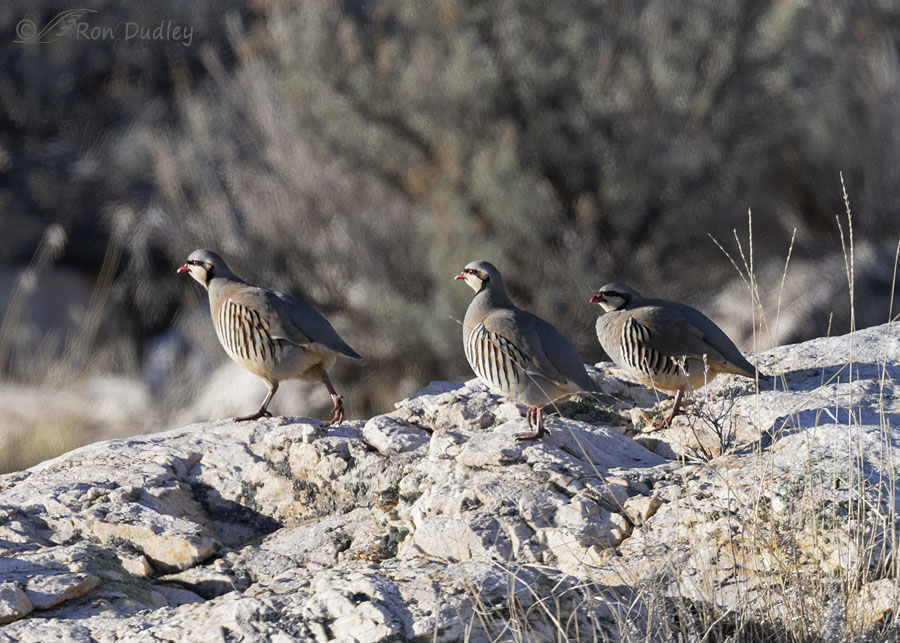
These are the Chukars on his left that he was interacting with.
After a while his behavior changed dramatically, from presumed aggressiveness to what I interpreted as being intimidated and/or fearful. He crouched down in preparation for an explosive takeoff and held this posture for a long time. But in the end he didn’t take off, instead he walked down the rock to a ledge, hopped down and disappeared in the vegetation.
Over the years I’ve spent countless hours up close and personal with Chukars, but this was the first time I’d ever seen (or at least noticed) this particular behavior. I’d be interested in knowing if any of my bird photographer friends or regular blog followers are familiar with it.
Ron
sensational series
super
Cool photos! I have zero idea about why the silent open-beak pose, but I want to add the thought balloon “Get off my lawn!” to that third pic. He’s just a bit leery of saying it out loud. 😉
“He’s just a bit leery of saying it out loud.”
Not necessary, Chris. That aggressive posture speaks louder than words.
Come for the great photos, but definitely stay for the very interesting details of bird behavior! Thanks again for a great post that hits both very well.
Glad you appreciate the bird behavior, Bill. Most of today’s photos weren’t great ones but for some of us the behaviors make up for it.
From my years of chasing chukars (see my blog Chukar Culture) I’ve heard the rally call many, many times. My take on the open-beak behavior (which I’d never seen so clearly) is that the lone bird is trying to pinpoint the birds it’s listening to and gauge if it’s safe to join them. The covey will always try to re-form after it’s been busted, but they’re very wary (like most birds) if they know a predator’s in the area. The mystery is why its mouth is open: does that help it locate the birds somehow? Is it getting ready to reply? Only its hairdresser knows for sure. Thanks for your wonderful images and stories about these incredible birds. There’s no other source I’ve found with such fantastic visual information!
“Only its hairdresser knows for sure.”
Robert, that’s probably all we can be confident of. 🙂
I’m very appreciative of your kind words about my blog.
Very interesting – and great photography, as usual.
Thanks, Judy.
Not sure if you’re a Monty Python fan Ron – the Chukar behavior reminds me of the line ‘I spit in your general direction.’ Made me laugh!!! As Everett stated – we don’t see Chukar’s in AZ. They are very handsome/pretty birds!
Kathleen, I’m not a fanatic about Monty Python but I do enjoy some of their stuff – if I’m in the right mood.
Very interesting Ron although I have never seen one. They do not reside here No Chukars in our area. Good shots and videos thanks for posting.
Everett, as you know, Chukars have been introduced. Some states have imported them (mostly western states) and other states haven’t. Maybe AZ is one of the latter.
Thanks Ron – I then looked that up re AZ Game & Fish and they say that thousands were released into Arizona in the 1970’s at 37 different sites, but almost all failed. Right now the only successful sites are in and around canyons in far NW AZ north of the Colorado River. Really interesting birds. Wish they had made it here or near where we are.
Your posts are the only time I’ve ever seen Chukars; I appreciate all your educative shots and dialogue.
Much appreciated, Burrdoo.
Beautiful and interesting! 🙂 Obviously the Chukars know what it all means….. 😉 Particularly like the shot of the 3 in the group to his left – wing stripes REALLY stand out. Hopefully someone will be able to answer the question.
“Obviously the Chukars know what it all means.”
I guess I’ll have to learn to speak “Chukar”. 🙂 Thanks, Judy.
Great shots. Always valuable to witness previously unseen behaviors.
Thanks, Brett.
Oops!
Not to worry. I deleted your repeated comment.
Very interesting ! I’ll be checking back to your posse responses to
see if anyone can fill us in on this interesting “behavior”. The very
white rocks– is that salt? Ice rime ? Or are the minerals in them
actually very white ?
Kris, those white rocks are tintic quartzite, formed 540-570 million years ago. They’re the most dominant rocks on the north end of the island. South of there on the island, the quartzite rocks disappear and much darker and older Farmington Canyon Complex rocks become dominant.
https://featheredphotography.com/blog/2022/03/29/a-pronghorn-buck-a-rock-wren-and-some-antelope-island-geology/
Not being at all familiar with Chukars, I have no clue about the silent open beak behavior. It does have an aberrant feeling about it.
It sure seemed aberrant to me, Michael. But then what do I know? Maybe I’ve seen it before and just didn’t notice. I don’t think so though…