
Green-tailed Towhee (finally!)
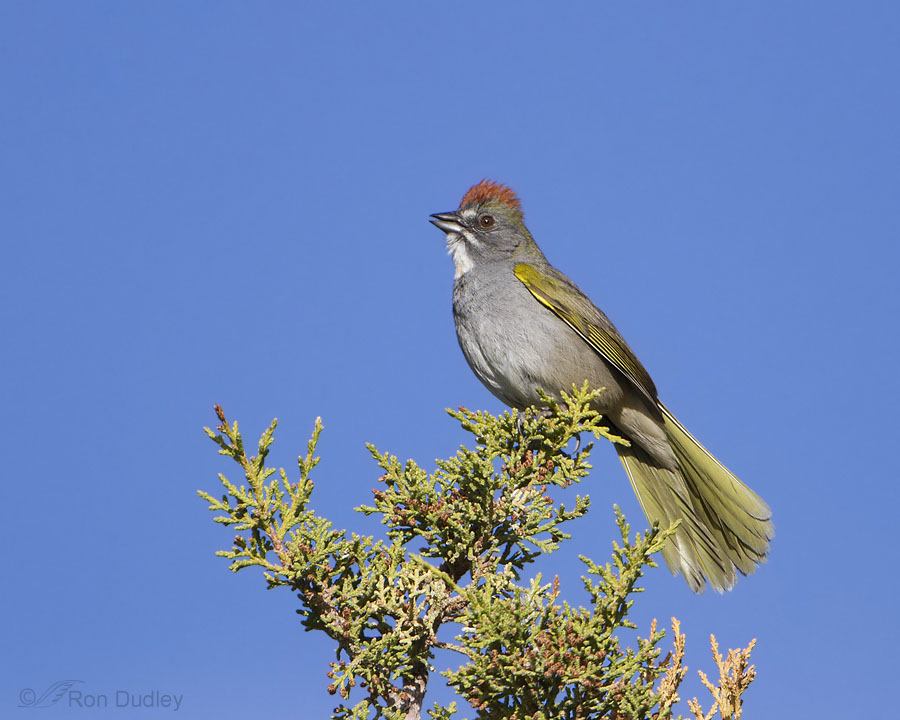
As a result of its secretive nature the Green-tailed Towhee is one of the least well-known of all North American birds.

As a result of its secretive nature the Green-tailed Towhee is one of the least well-known of all North American birds.
Yesterday morning I found this Western Meadowlark perched up high, in pretty good light and with a clean background so I couldn’t resist firing away.
I heard some very good news on the Barn Owl front recently. Hawkwatch International reports that a pair of Barn Owls has taken up residence in one of the kestrel nest boxes that HI keeps an eye on and they have laid 5 eggs!
Sometimes a single bird saves the day for the bird photographer. That was exactly the case last Wednesday.
Last week we spent a few days camping and exploring Utah’s west desert. A herd of Mule Deer composed of over a dozen animals hung around the general vicinity of our campsite for most of the time we were there. They still had most of their winter coat so they were scruffy and sun-bleached but they displayed a couple of interesting behaviors that I was able to photograph.
I’ve mentioned before how very reluctant Chukars are to fly. They much prefer to scurry away through the grasses whenever they feel insecure or threatened.
And that reluctance also applies when they’re ready to leave an elevated perch. They’ll nearly always find a way to scramble down a big rock rather than fly from it like most other birds would. That tendency was demonstrated to me twice yesterday morning on Antelope Island.
The Gray Partridge has a fairly limited range in North America and most folks don’t get to see them so I thought some of my readers might be interested in a post on the species. This bird prefers the grasslands and grainfields of our northern wheat-belt so they’re fairly common on our family farm in northwest Montana.
Gray Partridges are often called Hungarian Partridges, or “Huns” for short.
I’m primarily a bird photographer but when I’m in the field I do see other types of wildlife and I’m not hesitant to photograph them in the least.
As I reported on my last post, Mia and I found two Mountain Plovers on Antelope Island yesterday. They’re rare in Utah and I had never seen the species before, even in my travels to Montana and Wyoming where they’re more common. It was a very exciting day.
We had a wonderful time out on the west desert again this morning. The light was great, the birds were singing and everything was clear, crisp and clean. This post is meant to give you a feel for what it was like.
I spotted this adult Red-tailed Hawk perched on the side of a hill and hoped to get some take-off shots as it lifted off and then perhaps some full flight images. I always try to anticipate direction of take-off in this type of situation and I was pretty sure it would lift off to my left in the direction it’s facing. But I was wrong…
Our Chukars are generally easier to approach in the spring and early summer than they are the rest of the year. Right now, pair bonds are being formed and the birds seem more concerned with others of their own kind than they are about me and my pickup.
This was one of my stranger encounters with the bird world, though I’ll preface my narrative by admitting that I don’t have a lot of experience with nightjars of any species so perhaps what this bird was doing wasn’t really so unusual. I just don’t know.
Some of you may remember that on February 17th I posted about the problem of birds getting caught in discarded fishing line at Willow Pond, one of our urban fisheries here in Murray, Utah. I had photographed some Common Mergansers that had fishing line entangled on their bodies and fish hooks stuck in their bills. This merganser had lost a foot to fishing line. Another had a fish-hook stuck in its bill and other ducks had line wrapped around their legs and wings. Here’s a link to that original post: https://featheredphotography.com/blog/2013/02/17/one-footed-merganser-in-a-hurry/#comment-21517 In comments, many of you were as disturbed as I was about the carelessness of anglers and the resulting suffering of birds and some suggested a variety of methods to help address the issue. I chose to contact Tom Wharton, a long-time and highly respected columnist for the Salt Lake Tribune, to see if he was interested in doing a story on the situation at Willow Pond. When I sent him a link to the merganser post he responded almost immediately and asked if I would meet him at the pond and give him some background. So a couple of days later Mia and I met him at the pond and spent most of an hour with him reviewing the situation. He was enthusiastic about writing a column on the subject and trying to help birds. That column was published three days ago but I’ve been on a camping/photo trip and couldn’t post about it until now. But since many of you had asked me to update any developments…
Sometimes a change of position of just a few inches can have a fairly dramatic affect on the overall “feel” of an image. That was the case with this Antelope Island Chukar. 1600, f/8, ISO 400, 500 f/4, 1.4 tc, natural light I found the bird on a rock ledge and slightly above me which gave an almost eye-level perspective that I like. Occasionally it would call, as they’re very prone to do. 1600, f/8, ISO 400, 500 f/4, 1.4 tc, natural light But then it began to walk a short distance to my right (I’m always surprised that the bottoms of their feet are yellow)… 1600, f/7.1, ISO 400, 500 f/4, 1.4 tc, natural light which brought the snow-covered hillside in the background into play. At first there was a mix of snow and blue sky back there… 2000, f/7.1, ISO 400, 500 f/4, 1.4 tc, natural light but then I deliberately raised my window a couple of inches (as usual I was shooting from my pickup) to take the blue sky out of the picture. And the bird obliged me by calling once again. Most of the snow is finally gone from the island now. Even the roads to the Frary Peak trailhead and White Rock Bay are open – they’ve been closed for months due to snow. Hopefully that’s a sign that the curlews and Willets (and other spring birds) won’t be far behind. Hope so – it’s been a long dry spell on the island. Ron